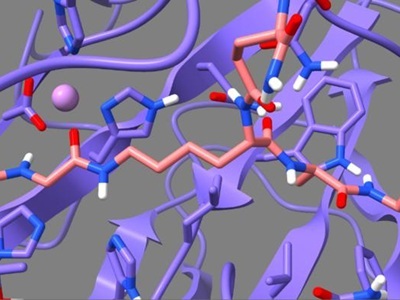
The study examined an enzyme called LytU. In the illustration, the LytU enzyme is shown in purple, and the substrate is salmon pink. Credit: Perttu Perm
Researchers in Finland have identified an enzyme in Staphylococcus aureus bacterium that modifies the structure of the bacterium’s cell wall, possibly increasing its resistance to the antibiotic vancomycin.
The discovery offers a new perspective on how bacteria adapt to antibiotic resistance and may help develop future strategies to combat antibiotic resistance.
Staphylococcus aureus is particularly notorious for its ability to develop resistance to multiple antibiotics, including vancomycin, which is commonly used to treat serious infections.
The study, published in Nature Communications, examined an enzyme called LytU, which is involved in the remodeling of the bacterial cell wall. The cell wall protects bacterium from external stresses, maintains the cell shape and is also a target for many antibiotics.
To their surprise, the researchers discovered that LytU does not behave like other known proteins in the enzyme family. For example, instead of cutting the usual bonds in peptidoglycan—the main component of the cell wall— LytU broke a specific bridge bond in the structure that plays a key role in cell wall cross-linking.
In the experiments, the bacteria that produced more LytU enzymes were about 30 times more resistant to vancomycin than the control bacteria.
The study also showed that LytU activity must be tightly regulated: while increased expression can enhance vancomycin resistance, excessive enzyme activity disrupted normal cell wall construction.
“What makes this discovery particularly exciting is that we have identified an enzyme that connects two seemingly opposing processes: bacterial cell wall remodeling and antibiotic resistance,” said lead author Perttu Permi from the University of Jyväskylä.
Although further studies are needed to establish the contribution of LytU to antibiotic resistance in clinical isolates and adapted resistant strains, the experimental results provide a new molecular perspective on the relationship between cell wall remodeling and antibiotic resistance.
Data from University of Jyväskylä