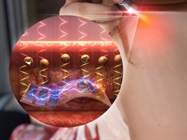
On-demand drug delivery has just been improved with the development of an in vivo medical device release using light. Professor Sei Kwang Hahn of the Department of Materials Science and Engineering and Professor Kilwon Cho of the Department of Chemical Engineering at POSTECH has pioneered this novel delivery system using organic photovoltaic cell coated nanoparticles. These nanoparticles convert near-infrared (NIR) light into visible light, enabling medical implant drug release on or in the body.
Applications for light-enabled drug delivery systems include diabetes, cardiovascular and cancer therapeutics. Their research findings were published in Nano Energy.
"The combination of a flexible photovoltaic cell and a drug delivery system enables on-demand drug release using light," said Professor Sei Kwang Hahn. "The drug delivery system is activated using near-infrared light that is harmless to the human body and is highly skin-penetrating."
He continued, "Since this enables nimble control of drug release of medical devices inserted into the body by using near-infrared light, it is highly anticipated to contribute to the development of phototherapy technology using implantable medical devices."
Image credit: POSTECH