Anti-Inflammatory Protein is the Key to Improving Rheumatoid Arthritis

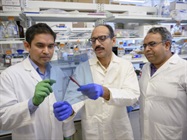
Study authors Mahamudul Haque, Salah-Uddin Ahmed, and Anil K. Singh look at a protein array in their lab at the WSU Health Sciences Spokane campus.

Rheumatoid arthritis is a devastating disease where the immune system mistakenly attacks the body’s own joint tissues. A research team at Washington State University has discovered a protein, GBP5, that plays a key role in suppressing inflammation in rheumatoid arthritis. Their research is published in the journal Arthritis & Rheumatology.

Senior author Salah-Uddin Ahmed, a professor in the College of Pharmacy and Pharmaceutical Sciences, said, “Our initial thought had been that the GBP5 protein played a role in causing the disease, but as we worked to decipher the mechanism of GBP5 in rheumatoid arthritis we found that it was induced in response to inflammation and was trying to cut back inflammation before it goes out of control.”

This discovery sets the stage for developments in new treatments to slow or halt the progress of the disease. First author Mahamudul Haque first stumbled upon GBP5 back in 2015. Haque and Ahmed now work to compare the expression of different genes in joint tissue from rheumatoid arthritis patients and non-diseased joint tissue.

Image credit: Cori Kogan, Washington State University Health Sciences Spokane

More News

  • Researchers Propose New Regulations for Food Packaging Chemicals

    Scientists have proposed a new way to prioritize regulatory review of the more than 15,000 chemicals used in food packaging and other food contact materials, most of which currently lack the safety data needed to protect consumers. read more
  • Brain Activity Mirrors the Shape of Each Breath

    Each individual breath—not just breathing rate—is closely linked to the pattern of electrical activity in brain regions tied to cognition, emotion and memory, according to a new study that could help explain how breathing disorders turn deadly. read more
  • Body's Organs Age in Distinct, Synchronized Waves

    The human body doesn't age at a single, steady pace. Instead, each organ follows its own timeline, and organs that age quickly tend to have "aging partners" that speed up in sync, according to a new study that mapped structural aging across 40 types of tissue. read more