Magnetic atoms exchange quantum information to react to spin changes, resulting in different material behaviors such as superconductivity. A quantum interaction can be initiated by exciting atoms with microwave pulses, but this method works too slowly to allow researchers to observe the transfer of quantum information.
Researchers at Delft University of Technology, in collaboration with RWTH Aachen University and the Research Center of Jülich managed to observe the quantum “conversation” between two titanium atoms through scanning tunneling microscopy by trying a new direct-current pump-probe technique rather than microwave pulses.
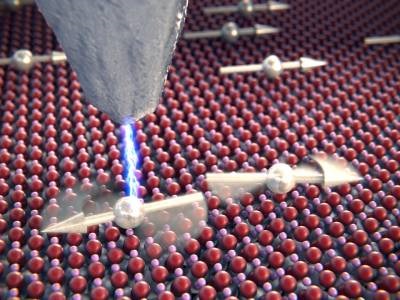
Through the direct-current pump-probe scheme, researchers rapidly inverted the spin of one of the two atoms placed just over one nanometer apart. Researchers found that spin coherence was preserved and were able to observe the free evolution of the entangled spins using electron spin resonance-STM. The research was published in Science on May 28, 2021.
“We always assumed that during this process, the delicate quantum information - the so-called coherence - was lost,” said Sander Otte, the leader of the team that performed the experiment. “... Here we used two atoms, but what happens when you use three? Or ten, or a thousand? Nobody can predict that, as computing power falls short for such numbers. Perhaps one day we will be able to listen to quantum conversations that nobody could ever hear before.”
The discovery of a technique to better observe quantum interactions could bolster the study of quantum bits and better the understanding of complex material behaviors.
Photo: Artist's impression of the experiment, where an electric pulse is applied to a titanium atom. As a result, its magnetic moment suddenly flips around. A neighbouring titanium atom (right) reacts to this motion, but can't keep pace with the fast movement. As such, an exchange of magnetic quantum information between the atoms is initiated. Credit: TU Delft/Scixel