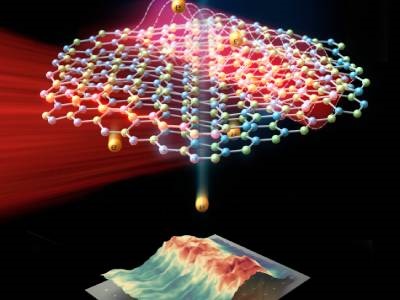
Single-layer materials such as graphene create unique hybrid waves of sound and light, known as phonon-polaritons, and are an attractive material for developing nanophotonics platforms. However, most methods of measuring light in 2D materials disturb wave motions, making it difficult to observe the dynamics of 2D polariton wave packets. A team at the Technion-Israel Institute of Technology has developed a new technique that allows researchers to observe the propagation of phonon-polaritons in a 2D material for the first time.
The team used a new pump-probe technique based on electron emission to access the spatiotemporal dynamics of the polaritons. The wave packets were imaged with an ultrafast transmission electron microscope (UTEM) in 50 femtosecond resolution. Researchers found that the sound-light pulses spontaneously sped up and slowed down, and could even split into two separate pulses that moved at different speeds.
The study not only allowed for the observation and recording of wave behavior, but showed the value of UTEM techniques for studying light within 2D materials. This research was conducted at the Robert and Ruth Magid Electron Beam Quantum Dynamics LLaboratory and published in Science.
“We can use the system to study different physical phenomena that are not otherwise accessible. We are planning experiments that will measure vortices of light, experiments in Chaos Theory, and simulations of phenomena that occur near black holes,” said Ido Kaminer, of the Faculty of Electrical & Computer Engineering and Solid State Institute at Technion. “Moreover, our findings may permit the production of atomically thin fiber optic ‘cables,’ which could be placed within electrical circuits and transmit data without overheating the system - a task that is currently facing considerable challenges due to circuit minimization.”
The research represents a breakthrough in the study of light pulses in 2D materials, broadens the capabilities of electron microscopy and promotes the possibility of optical communication through atomically thin layers.