Exosomes, the biological nano-capsules that cells produce to transport delicate molecules throughout the body, are a prime candidate for drug delivery due to their ability to withstand breakdown in the gut and bloodstream and penetrate the blood-brain-barrier. However, harvesting and purifying these extracellular couriers from body fluid sources like serum and milk is a complex process and difficult to scale. Researchers from Virginia Tech have now developed a new scalable method for isolating exosomes from unpasteurized cow’s milk that may help expand their use for oral drug delivery.
The researchers’ multi-step, cost-effective purification process optimizes filtration methods and the timing of temperature and chemical treatments affecting calcium levels to harvest an abundant and sufficiently pure yield of exosomes suitable for use in pharmaceutical labs. The team adapted tangential flow filtration technology previously developed by Mayo Clinic researcher Joy Wolfram to help isolate the milk exosomes. The team’s method allows for about one cup of purified exosomes to be extracted from every gallon of unpasteurized milk. The research was published in Nanotheranostics.
“Imagine instead of getting a vaccine shot, your nurse hands you a milkshake instead. Another milkshake may contain exosomes loaded with a therapeutic peptide designed to protect internal organs such as the heart from myocardial infarction,” said corresponding author Rob Gourdie, who is the director of the Center for Vascular and Heart Research at the Fralin Biomedical Research Institute at VTC. “Improving the viability of using exosomes opens up a wide range of drug delivery methods with unlimited clinical applications.”
Research into the pharmaceutical application of exosomes, particularly for the delivery of fragile drugs like peptides and microRNAs, has surged over the past decade. The new purification method offers a new path toward the industrial scalability of this drug delivery method, according to Gourdie.
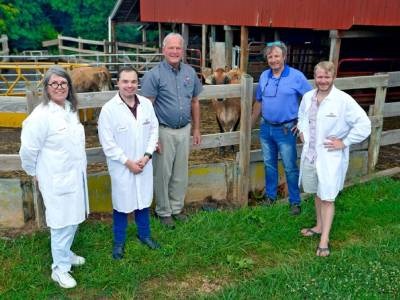
Photo: Virginia Tech scientists with Donnie Montgomery (center) of local dairy producer Homestead Creamery, which provided the scientists with unpasteurized milk samples for experimentation. The research team (from left), Jane Jourdan, Kevin Pridham, Rob Gourdie and Spencer Marsh, developed a new protocol for purifying a large amount of exosomes from milk for potential drug delivery applications. Credit: Whitney Slightham/Virginia Tech