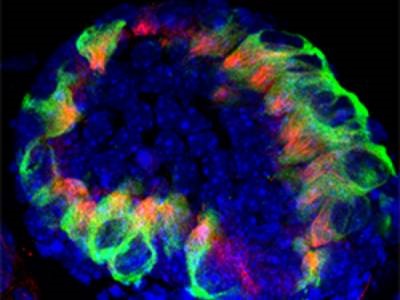
The hair cells inside our ears — much different from the hair follicles on our skin — mediate our perception of sound waves and thus play an important role in our ability to hear. Consequently, loss of cochlear hair cells due to disease, toxins, aging or exposure to loud sounds can result in partial or complete hearing loss. These sensory hair cells do not naturally regenerate in mammals, but researchers are exploring potential treatments to encourage hair cell regeneration and reverse hearing loss. Now, researchers from Nanjing University have produced mammalian cochlear organoids in vitro, allowing for high-throughput screening of thousands of drug candidates to identify the “hairiest” results.
These lab-grown cochlear organoids were derived from LGR5+ and LGR5- supporting cells and used to test more than 1,000 FDA-approved small molecule drugs for hair cell regeneration capabilities. The use of mammalian supporting cells to produce the organoids was important, as zebrafish hair cells, which are commonly used for large-scale screening, have the ability to spontaneously regenerate. The researchers found that 91 candidates promoted hair cell differentiation from the organoid cells, and that regorafenib, an anti-cancer drug, was the most effective at regenerating hair cells.
Regorafenib was able to promote hair cell development not only in the organoids, but also in mouse cochlear tissues, and could even regenerate mouse hair cells that were destroyed by chemical exposure. This study was published in Stem Cell Reports.
The researchers say their method could enable further high-throughput screening for hair cell regeneration treatments in mammals, and they plan to further investigate regorafenib to determine its safety and ability to induce hair cells in human cochleas.
Photo: Confocal microscopic image of a mouse cochlear organoid displaying hair cells (green) and their ciliary structures (red). Credit: Qing Liu, Nanjing University, China