Primary amines are found in more than half of all pharmaceuticals, and unfortunately, synthesizing them can be very energy intensive and produce a lot of waste. It is estimated that for every kilogram of a drug produced, about 100 kg of waste is left behind from the process. Researchers from the University of Bath have now developed a new synthesis method that can both reduce waste production and energy use and consolidate the process into just one step.
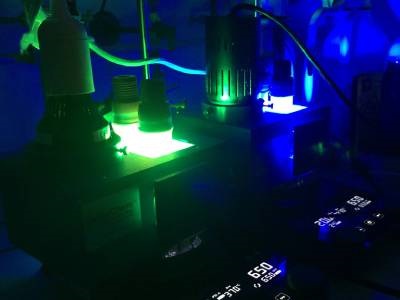
The new process relies on the use of a photocatalyst that is activated with blue light in combination with hydrogen atom transfer (HAT) catalysis. This technique allows for hydroaminoalkylation, or the net insertion of an alkene into an amine α-C–H bond, of styrenes with unprotected primary alkylamines. This method is more flexible than metal-catalyzed hydroaminoalkylation and allows for direct synthesis of α-trisubstituted primary amines, while also using less energy and producing less waste than conventional synthesis methods.
The researchers were able to use this method to successfully synthesize the multiple sclerosis drug Fingolimod, which is developed by Novartis under the brand name Gilenya, in only one step with 100% atom economy. This technique could prove useful for the discovery and development of new drugs by making it faster, easier and more sustainable to synthesize new chemical structures for testing, the researchers said. This study was published in the Journal of the American Chemical Society.
“The aim [in drug discovery] is to make thousands of different derivatives for biological testing, and our new process gives chemists a way to connect certain atoms that simply wasn’t available before,” said corresponding author Alex Cresswell. “This should help to speed up the discovery process.”
The team is now collaborating with several pharmaceutical companies in the hopes of scaling up the process for manufacturing applications.
Photo: The reaction uses a catalyst activated with blue LED light. Credit: Alex Cresswell