The opioid addiction epidemic has led to thousands of overdose deaths each year for the last several years, and many researchers have been hard at work searching for ways to combat the problem and help save lives. One approach to stemming the epidemic is to develop an alternative painkiller that provides the same level of relief as drugs like morphine, oxycodone and fentanyl, without the risk of causing tolerance or suppressing respiration. Scientists at Scripps Research Institute have introduced two new compounds that could offer a safer alternative to opioid analgesics, which have so far exhibited promising results in mouse studies.
The new compounds relieve pain by binding to the same μ-opioid receptors as currently available drugs, but in a way that leaves the receptors open and available to the body’s own natural pain-relieving substances. Both compounds are biased agonists that preferentially engage the signaling pathways that provide pain relief over those that lead to suppressed breathing, and were engineered to avoid the potentially deadly β-arrestin signaling cascade seen in opioid overdoses.
One of the compounds, SR-17018, is especially promising, as it has shown an ability to provide sustained pain relief over time without the development of tolerance. In other words, this compound would not require increased doses to maintain its efficacy over time, reducing the risk of overdose. The compound also wears off in a slow, tapering manner rather than in a quick rush, which could curb dependence issues, noted study coauthor Laura Bohn.
The other compound, SR-14968, is more potent than SR-17018 and more likely of the two to induce respiratory suppression, but only at higher doses than are needed to relieve pain. SR-14968 is also responsive to the overdose rescue medication naloxone in the case that high enough doses were given to suppress breathing. This research was published in the Proceedings of the National Academy of Sciences.
“Severe and chronic pain associated with surgery, nerve damage, and trauma require strong pain relief,” said Bohn. “Safer solutions are needed. We believe these new compounds are a big step in the right direction.”
Because SR-17018 does not lead to a tolerance, it could be especially helpful for sufferers of chronic pain, and performed especially well in mouse studies of chemotherapy-induced neuropathic pain. The team is continuing to refine and test these compounds so they could eventually be tested in a clinical setting going forward.
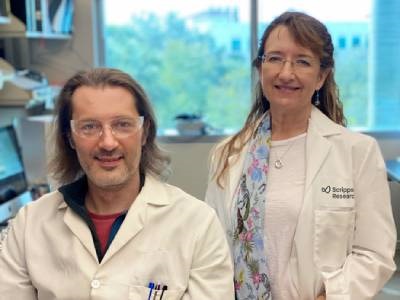
Photo: Biochemist Laura Bohn (right), PhD, and Sr. Staff Scientist Edward Stahl describe a compound called SR-17018, which activates the same pain-relieving receptor as opioid drugs; however, it binds in a different way, augmenting pain relief while diminishing overdose risk in mouse studies. Credit: Courtesy of Scripps Research