Breast cancer can often be treated effectively with hormone therapies, but in approximately 40% of cases, the effectiveness of these treatments wanes over time. Studying the effectiveness of hormone therapies in treating breast cancer is difficult due to the fact that breast cancer cell cultures typically lose their hormone receptors under lab conditions. A research team from Aalto University sought to understand why this disappearance of hormone receptors occurs, and managed to design a new breast cancer model that maintains these receptors by leveraging the mechanical and chemical properties of a specially designed gel-based matrix scaffold.
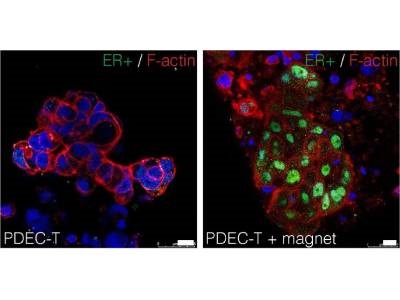
The researchers took an interdisciplinary approach to the problem, combining their knowledge of cancer biology with materials chemistry and soft matter physics. After growing patient-derived breast cancer cells and tissue on various 3D scaffolds with different properties, they found that a scaffold that more closely mimicked breast tissue, specifically with regard to matrix stiffness, produced the best results and retained hormone receptors. Through their discovery that matrix stiffness was a key factor in regulating hormone signaling, the team designed a hydrogel-based mini breast cancer model that can be used to test new hormone therapies in a laboratory environment. This study was published in Nature Communications.
“Our ability to control the mechanical, biochemical and chemical functionalities of the hydrogel-based nanoscaffolds offers long-term study of patient-derived tissues, paving the way for a novel and predictive preclinical model,” said Nonappa, who led the material science part of this work.
“The researchers are working with cancer centers and pharmaceutical companies to explore the potential of using their new model to promote breast cancer drug development, and expressed gratitude for the more than 400 breast cancer patients and other breast tissue donors who helped make the research possible.
Photo: Breast cancer tissue in a culture model in which hormone receptors disappear (left) and within the culture model developed in this study which maintains the hormone receptors (right). The hormone receptors are indicated in green. Credit: Pauliina Munne