Researchers have developed a rechargeable lithium-ion battery in the form of an ultra-long fiber that could be woven into fabrics. The battery could enable a wide variety of wearable electronic devices, and might even be used to make 3D-printed batteries in virtually any shape.
In a proof of concept, the team behind the new battery technology has produced the world’s longest flexible fiber battery, 140 meters long, to demonstrate that the material can be manufactured to arbitrarily long lengths.
The work is described in the journal Materials Today.
The new fiber battery is manufactured using novel battery gels and a standard fiber-drawing system that starts with a larger cylinder containing all the components and then heats it to just below its melting point. The material is drawn through a narrow opening to compress all the parts to a fraction of their original diameter, while maintaining all the original arrangement of parts.
The researchers envision new possibilities for self-powered communications, sensing, and computational devices that could be worn like ordinary clothing, as well as devices whose batteries could also double as structural parts.
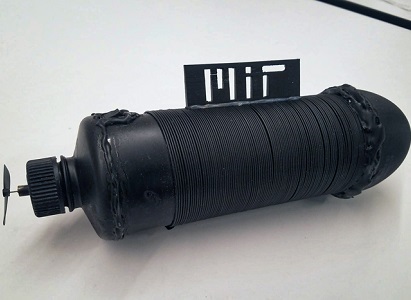
Photo: This submarine drone is powered by a 20-meter-long fiber battery that is wrapped on its surface. Credit: Tural Khudiyev, Jung Tae Lee, Benjamin Grena, Yoel Fink et al