The spike protein of SARS-CoV-2 plays a major role in its ability to infect human cells, making it a prime target for drug and vaccine development efforts throughout the COVID-19 pandemic. Laboratories around the world have turned to advanced techniques and high-throughput screening methods in order to identify new potential candidates that could disrupt the SARS-CoV-2 spike protein and thus help prevent and treat the COVID-19 disease. A novel screening method developed at Oregon State University (OSU) has now revealed that two compounds produced by Cannabis sativa hemp plants are able to bind to the SARS-CoV-2 spike protein and block its entry into cells.
The OSU researchers utilized a technique called affinity selection mass spectrometry (AS-MS) to screen a range of botanicals including hemp, red clover, wild yam, hops and three species of licorice for potential ligands to the SARS-CoV-2 spike protein. This process involved immobilizing subunits of the spike protein on magnetic microbeads and incubating them with the various potential ligands so that the compounds that bind to the protein can be isolated from non-binding compounds and subsequently identified via ultra high performance liquid chromatography (UHPLC)-MS. Several cannabinoid ligands were identified through this method and ranked based on their affinity to the protein, with the highest-affinity ligands being selected for further testing.
The two compounds with the greatest affinity for the spike protein were identified as cannabigerolic acid (CBGA) and cannabidiolic acid (CBDA), which are precursors to CBG and CBD, respectively. When the live SARS-CoV-2 virus was incubated with these compounds and then used to infect Vero E6 cells, the researchers found an absence of viral RNA in the cells 24 hours post-infection. The compounds also prevented infection of human epithelial cells (HEK 293T ACE2) by a pseudovirus expressing the SARS-CoV-2 spike protein. Additionally, the compounds were effective at blocking the infection of Vero E6 cells by the Alpha and Beta variants of the virus. This research was published in the Journal of Natural Products.
“These compounds can be taken orally and have a long history of safe use in humans,” said first author Richard van Breemen. “They have the potential to prevent as well as treat infection by SARS-CoV-2 … Our data show CBDA and CBGA are effective against the two variants we looked at, and we hope that trend will extend to other existing and future variants.”
Van Breemen noted that another botanical compound - licochalcone A, which comes from licorice - has also been found to bind to the spike protein, and the researchers hope to test this compound’s activity against the live SARS-CoV-2 virus in the future.
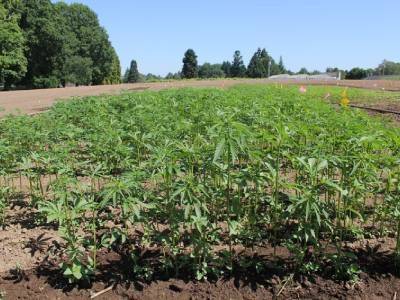
Photo: Hemp plants in a field. Credit: OSU