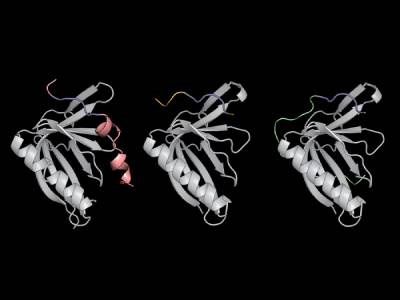
Short linear motifs (SLiMs) are short stretches of about 3-10 amino acids that mediate protein-protein interactions and could be used in drug development to disrupt certain disease-causing proteins. There are several methods available for screening SLiMs, however, not all can account for other factors affecting variations in binding affinity. In order to explore how “extended” SLiMs - i.e. longer stretches of amino acids on either side of the SLiM’s “core” - may play a role in binding affinity, MIT researchers developed their own method to screen hundreds of thousands of longer amino acid sequences and identify a protein with the highest possible binding affinity to another protein known to exacerbate the spread of cancer.
The screening method, called MassTitr, involves fluorescence-activated cell sorting (FACS) of a library of peptide-displaying bacteria, after which deep sequencing is used to further identify the binding signal for each peptide. This method allows for longer sequences, containing 36 amino acids, to be screened and for peptides with a broad range of binding affinities to be identified and explored. This technique was used to screen a library of more than 400,000 peptides spanning the human proteome in order to identify which “extended” SLiMs facilitated binding with the protein ENAH. ENAH, while critical for allowing movement of healthy cells, has also been found to facilitate the spread of cancer, and research has shown that reduced amounts of ENAH decrease the ability for cancer cells to invade other tissues.
The researchers managed to identify 33 SLiM-containing proteins that bind go ENAH, 19 of which are potentially novel binding partners; additionally, they discovered that three patterns of amino acids present in the “extended” SLiMs, found on either side of the SLiM “core,” facilitated even tighter binding to ENAH compared to other proteins with different extended patterns. Ultimately, one extended SLiM found in the protein PCARE allowed the protein to bind to ENAH with the highest known affinity seen to date.
Further examination of PCARE using X-ray crystallography in combination with the protein design software dTERMen revealed how the extended SLiM allows PCARE to selectively bind to ENAH over two nearly identical proteins, VASP and EVL. The researchers found that the additional amino acid patterns surrounding the SLiM core slightly changed the shape of ENAH in order to allow the strong binding to occur, but because the sequences did not facilitate the same structural change in VASP and EVL, PCARE did not bind to these other proteins as tightly. This research was published in two papers in the journal eLife, one on Dec. 2, 2021 and the other on Jan. 25, 2022.
“The ability to test hundreds of thousands of potential SLiMs for binding provides a powerful tool to explore why proteins prefer specific SLiM partners over others,” said Amy Keating, senior author on both studies. “As we gain an understanding of the tricks that a protein uses to select its partners, we can apply these in protein design to our own binders to modulate protein function for research and therapeutic purposes.”
In fact, using the insights gained from this work, first author Theresa Hwang designed her own protein that could bind to ENAH with unprecedented affinity and specificity. This shows how further study and screening of longer protein sequences could aid in future drug discovery to better target proteins involved in diseases like cancer.
Photo: Short linear motifs (blue) use flanking regions outside their core amino acid sequence to recognize proteins such as ENAH (gray). Credit: Theresa Hwang