Magnetometers, which measure the strength, direction and relative changes of magnetic fields, have a broad range of applications from material science and archeology to biomedicine and astronomy. Some of the weakest magnetic fields of interest, such as those produced by the brain, require unique technologies to detect, including superconducting devices and atomic vapors, but for many years magnetic sensors have not reached an energy resolution per bandwidth (ER) better than ER = ħ (Planck’s constant). Now, researchers at the Institut de Ciències Fotòniques (Institute of Photonic Sciences), or ICFO, have developed a novel Bose-Einstein condensate magnetometer that senses previously undetectable weak magnetic fields with a resolution 17 better than any previous technology.
The magnetometer uses a single-domain Bose-Einstein condensate made from rubidium atoms (87Rb), which is cooled to nano-Kelvin temperatures by evaporative cooling in a near-perfect vacuum. The condensate is held in an optical trap and, in the ultracold-temperature conditions, forms a magnetic superfluid that can reorient itself in response to magnetic fields, with zero friction or viscosity. These conditions allow the condensate to respond even to extremely weak magnetic fields, resulting in an unprecedented energy resolution per bandwidth of ER= 0.075(16)ħ.
The new sensor overcomes the sensitivity limits of other magnetometer technologies by minimizing quantum noise, resulting in greatly improved spatial, temporal and field resolution of the sensor. The researchers demonstrated that their magnetometer can pick up previously undetectable fields, and stated that their sensor could be further improved with a better readout technique or by using Bose-Einstein condensates made from different atoms, such as antiferromagnetic 23Na. Overall, the research shows that ħ is no longer an impassable limit for magnetic sensing technology. This work was published in PNAS.
The novel magnetometer opens up opportunities for measuring the extremely weak, brief and localized magnetic fields related to brain function, making it a potential new tool in the fields of neuroscience and biomedicine, among other applications.
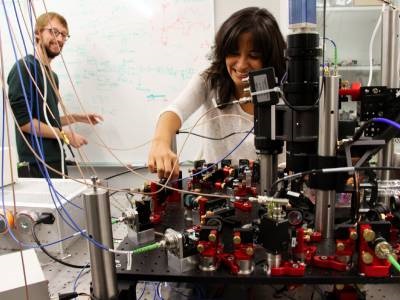
Photo: Silvana Palacios and Simon Coop, co-authors of the paper, manipulating the experimental setup in the lab at ICFO. Credit: ICFO