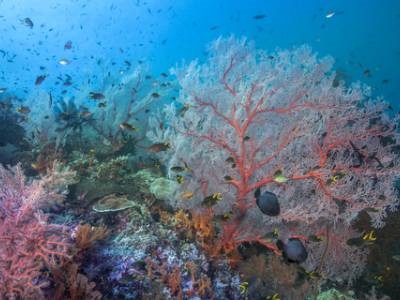
Environmental DNA (eDNA) metabarcoding allows researchers to assess biodiversity by sequencing the DNA left behind by organisms as they interact with their surroundings. The technique helps overcome the limitations of visual surveys, which can miss particularly elusive species, such as those that inhabit the deep crevices of coral reefs. The benefits of eDNA metabarcoding was recently demonstrated in a study conducted by researchers from the University of Montpellier and ETH Zurich, which revealed 16% higher diversity of reef fish than estimated through underwater visual censuses.
eDNA metabarcoding typically involves polymerase chain reaction (PCR) amplification of DNA fragments found in environmental samples, followed by next-generation sequencing. Universal PCR primers are used in order to reveal the species composition of the sample rather than to detect a specific species. The eDNA sequences can then be compared with reference databases of reliably identified specimens in order to determine which species were present in the location the sample was taken from.
The research team collected a total of 226 water samples from 26 sites in five tropical marine regions–the Caribbean, Central Pacific, Southwest Pacific, Coral Triangle and Western Indian Ocean–in 2017 and 2019. Sequencing of the eDNA from these samples revealed 16% higher fish biodiversity in coral reefs when compared to the 2047 underwater visual censuses from the Reef Life Survey. A total of 2,650 taxa were identified, with 25% more families found than in visual surveys.
The study also found more pelagic fish–those that swim in the open water–interacting with the reef habitats, and more crypto-benthic species–those that are often difficult to detect because they live near the seafloor and tend to hide through camouflaging or hiding in caves and crevices. The researchers noted that even species that don’t live permanently in the reefs, such as mackerel, tuna and sharks from the Carcharhinidae family, are important to monitor as they are actively involved in the reef ecosystem through their larval stages or nocturnal migrations to the reef.
The study also revealed wide variations in the composition of species between different marine bioregions. For example, fish diversity in the Coral Triangle, which sits between Borneo, Papua New Guinea and the Philippines, was found to be exceptionally high, up to five times higher than in the Caribbean and with a particular abundance of herbivores and coral-eating species. In combination with visual surveys, the eDNA analysis provides a more complete understanding of the spatial organization of marine ecosystems. This study was published in Proceedings of the Royal Society B.
“Thanks to the eDNA method, we can detect many fish species and families much faster than with observations alone,” said Loïc Pellissier, a professor of ecosystems and landscape evolution at ETH Zurich and co-lead author of the paper.
The researchers noted that while eDNA metabarcoding provides valuable new insights into marine biodiversity, visual surveys are still essential, as not all species are fully covered in reference databases, and divers can also collect additional important information such as fish size and biomass. The researchers hope to sequence the DNA of more fish species in order to grow their reference databases, and also have another expedition planned to collect more water samples from tropical waters in the Indian Ocean between South Africa and Seychelles.