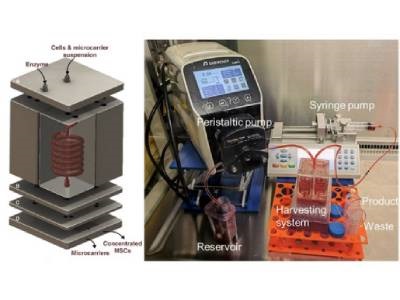
Stem cells offer promising treatment options for many types of diseases and injuries ranging from arthritis, to diabetes, to cancer, due to their unique ability to replace damaged cells. However, current methods used to harvest stem cells from bioreactors are labor-intensive, time-consuming and expensive, making large-scale stem cell manufacturing challenging and limiting widespread patient access to stem cell therapies. Now, researchers from the University of Technology Sydney, in collaboration with Australian biotechnology company Regeneus, have developed a novel 3D-printed harvesting system that lowers the costs and labor associated with stem cell harvesting, offering a potential avenue to improve stem production operations and expand patient access.
The new system was produced through a fast and precise 3D printing technique called digital light processing (DLP), which enabled the researchers to fabricate their complex design with high resolution and robustness. The system includes two micromixers, one spiral microfluidic separator and one zigzag-shaped microfluidic concentrator. The micromixers detach stem cells from their microcarriers through a combination of enzymatic treatment and gentle mechanical force, the separator channel uses inertial lift force and Dean drag force to direct microcarriers and stem cells to separate outlets based on their different sizes, and the concentrator channel uses a similar principle to concentrate the stem cells in the center of the channel.
The system was specifically designed for the processing of mesenchymal stem cells, a type of adult stem cell that can divide and differentiate into multiple tissue cells including bone, cartilage, muscle, fat and connective tissue. After first testing the system using microbeads, the team evaluated its efficacy at harvesting mesenchymal stem cells from a bioreactor. The team found that the system could successfully remove 100% of the microcarriers from the cells while recovering about 77% of cells in one round, which includes a five minute incubation time with enzyme and 20 seconds proceeding through the device. Including a second separation round increased recovery rate to up to 94%. The researchers found that stem cells collected from the system maintained their viability as well as their therapeutic potential. This research was published in Bioresources and Bioprocessing.
“Our cutting-edge technology, which uses 3D printing and microfluidics to integrate a number of production steps into one device, can help make stem cell therapies more widely available to patients at a lower cost,” said University of Technology Sydney Professor Majid Warkiani, who led the research. “While this world-first system is currently at the prototype stage, we are working closely with biotechnology companies to commercialise the technology. Importantly, it is a closed system with no human intervention, which is necessary for current good manufacturing practices.”
The researchers were also able to 3D print a multiplexed version of the system including additional mixers, spiral separators and zigzag concentrators, demonstrating the potential to further scale up stem cell harvesting operations for continuous, high-throughput applications.
Photo: (left) A diagram of the modular 3D printed microfluidics system. (right) A photograph of system setup. Credit: Majid Warkiani et al. Bioresources and Bioprinting 2022