Biocompatible piezoelectric materials could enable valuable biomedical applications, such as the development of implantable sensors and actuators, and the facilitation of tissue recovery and bone regeneration through piezoelectric stimulation in the body. However, research in this area has been limited due to the high cost and difficulty of fabricating novel biomaterials, and the fact that natural biological tissues tend to lack piezoelectricity on the macro scale. Now, researchers from the City University of Hong Kong have developed a new exfoliation technique to produce ultrathin layers of certain natural tissues, which they found recovers the tissues’’ piezoelectricity and potentially opens the door to new biomedical applications.
The researchers’ work focused on the small intestinal submucosa (SIS) of sheep, which has previously been found to have a weak piezoelectric effect but is generally seen to lack piezoelectric properties at the macro scale. The team sought to further investigate whether the SIS tissue could generate a piezoelectric effect and whether this effect could be measured quantitatively. Through a systematic investigation of the structure of the SIS, they found that the key to the material’s piezoelectricity lay in the hierarchical structure of its collagen fibers, which are arranged in hundreds of layers throughout the millimeters-thick tissue. They were able to measure the tissue’s intrinsic piezoelectric effect quantitatively for the first time, and found that due to the thickness of the tissue this effect is effectively “canceled out” between layers at the macro scale, according to first author Zhuomin Zhang.
With this information, the team was driven to develop a method to produce ultrathin films consisting of one or just a few SIS layers in order to recover the tissue’s piezoelectricity. The fabrication technique, known as van der Waals exfoliation (vdWE), is inspired by the processing method for two-dimensional materials like graphene and leverages the weak van der Waals force found between tissue layers. The process allows the repeated peeling of layers from the tissue, with a final film thickness as low as 100 nm, nearly 800 times thinner than the original non-exfoliated material. The researchers found that the piezoelectric coefficient of the tissue increased as film thickness decreased, up to a saturated level of about 3.3 pm/V, according to Zhengbao Yang, who led the research. With the thinner materials, the team was able to perform a quantitative study further probing the biological piezoelectricity of SIS and determining the origin of its biological piezoelectricity. This study was published in Advanced Materials.
“Based on our vdWE technique, the piezoresponse of the ultrathin films is increased by more than 20 times compared with the non-exfoliated original films. Since the problem of cancelation of piezoelectricity is overcome in the ultrathin film, we can detect piezoelectricity, thus making the application of piezoelectric biological tissues possible,” said Yang.
The research team also designed a biosensor to verify the practical application of piezoelectricity in the SIS ultrathin film, and found that its natural biocompatibility, flexibility and piezoelectricity make it a promising material for electromechanical microdevices in implantable or wearable electronics. In addition, the vdWE technique is easy and environmentally friendly, and can be applied to various other biological soft tissue materials with van der Waals layered structures, such as fish bladders and cow Achilles tendon.
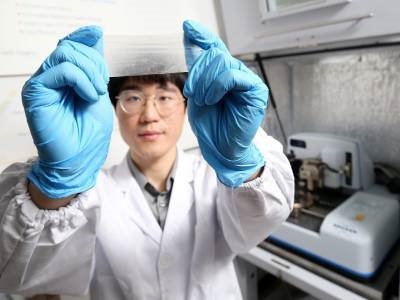
Photo: Zhang Zhuomin, a member of Dr. Yang Zhengbao’s research team, demonstrates the raw material of small intestine submucosa from sheep. Credit: City University of Hong Kong