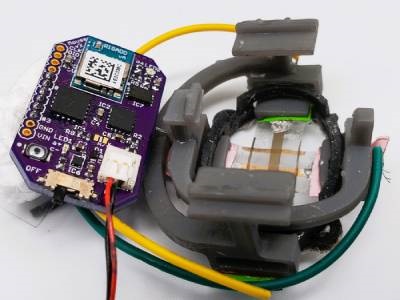
The FAST sensor device autonomously measures changes in subcutaneous tumor size. Credit: Stanford University
Mice with subcutaneous tumors are frequently used as models to screen potential cancer drugs. Current methods for measuring tumor regression in these animals are often time-consuming and labor-intensive, limiting the speed at which new therapies can be developed. Researchers from the Georgia Institute of Technology and Stanford University have created a new device that could help speed up the drug screening process: a wearable, autonomous sensor can continuously monitor changes in tumor size down to 10 µm.
The device, called FAST, which stands for “Flexible Autonomous Sensor measuring Tumors,” is composed of a stretchable skin-like polymer that includes an embedded layer of gold circuitry. The sensor is connected to a small, wireless, battery-operated electronic “backpack” that can be worn by the mouse without restricting its movement. The flexible sensor connects to the skin and covers the tumor, and the device measures strain on the sensor membrane to monitor changes in shape and size. More specifically, as the gold layer on the skin-like polymer membrane stretches or contracts, its electrical conductivity changes due to the formation or closure of microcracks; the device measures changes in electronic resistance, which can be mathematically translated into dimension and volume measurements. The device can continuously monitor tumor changes without human intervention once the sensor is placed, and measurement results can be wirelessly transmitted in real time to a smartphone.
The FAST device was used to measure tumor progression and regression in untreated and treated mice with subcutaneous human lung cancer tumors. Compared to caliper and bioluminescence measurement strategies, which took days to detect biologically significant changes in tumor size, the FAST sensor measured changes almost immediately after treatment, the authors wrote. After a week of treatment, the FAST measurements correlated closely with those obtained through caliper and bioluminescence methods. The main advantages of FAST over other methods include its ability to provide continuous monitoring over the entire experimental period, the ability of the flexible sensor to enshroud the tumor and measure shape changes that are difficult to discern with other methods, and its autonomous and non-invasive design that reduces the need to handle the animals, the researchers said. This study was published in Science Advances.
“It is a deceptively simple design, but these inherent advantages should be very interesting to the pharmaceutical and oncological communities,” said first author Alex Abramson. “FAST could significantly expedite, automate and lower the cost of the process of screening cancer therapies.”
The researchers noted that FAST devices are reusable and cost only about $60 to assemble. The device takes a few minutes to attach to the animal and can continuously read out measurements every five minutes for more than 24 hours on a 150-mA·hour battery, the authors wrote.