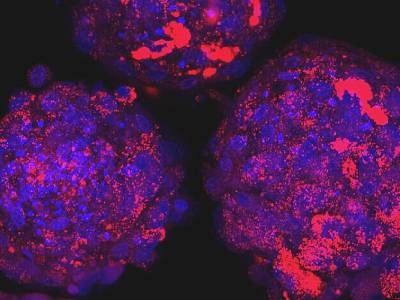
Human mesenchymal stem cells were differentiated into fat cells and the fat vacuoles were stained: stem cells and their differentiation products contain specific fatty sweet surface structures (glycolipids) that help distinguish them from each other. Credit: Institute of Cell and Tissue Culture Technologies, BOKU Vienna
Glycolipids are a class of molecules found in cell membranes that serve important roles such as maintaining membrane stability and facilitating cell-cell interactions. However, a lack of sensitive tools designed to study glycolipids means research into their impact on human health has yet to reach its full potential, with many questions about the structures and functions of specific glycolipids left unanswered. Now, a team led by University of Vienna researchers has developed a highly sensitive and automated liquid chromatography-mass spectrometry (LC-MS) based assay enabling details about certain glycolipids’ role in stem cell differentiation to be revealed.
Gangliosides are a type of glycolipid that change their composition on the cell membrane during stem cell differentiation and thus play a crucial role in formation of different cell types. Accurately identifying diverse ganglioside species is difficult in part due to the structure of glycolipids, which include both sugar and lipid components with differing properties. The researchers tackled the challenge of characterizing these molecules by establishing a novel workflow that includes a methyl tert-butyl ether-based extraction protocol, separation by reversed-phase ultrahigh-performance liquid chromatography and analysis via high-resolution mass spectrometry, which included the use of two parallel mass analyzers (orbitrap and ion trap) and multi-stage fragmentation. The team further used the open-source software Lipid Data Analyzer to develop an automated annotation workflow optimized for sphingolipids (a class of lipids that includes gangliosides).
The researchers used tissue samples derived from medical waste in their study, first isolating mesenchymal stem cells from the tissue and studying ganglioside patterns in both native stem cells and those differentiated toward becoming bone, cartilage or fat cells. Using their automated assay system, the team was able to annotate 137 unique gangliosides, which included 78 potential cell-state-specific markers as well as 38 previously unreported ganglioside species, the authors wrote. The ability to profile gangliosides throughout the differentiation process with unprecedented sensitivity and detail could aid in the understanding of a number of diseases, including neurodegenerative diseases like Alzheimer’s and Parkinson’s diseases, and cancer. Further, the techniques used by the authors could be adapted to study a wide range of other glycolipid classes. This research was published in the Journal of the American Chemical Society Au.
“Previous approaches have not been able to determine the multiple functions of gangliosides in Alzheimer’s disease, dementia or cancer because they lacked the necessary sensitivity. With our new method, we now provide a tool for the comprehensive analysis of gangliosides,” said Evelyn Rampler, group leader at the Institute of Analytical Chemistry at the University of Vienna. “Our study on human stem cells has shown that the existing patterns of gangliosides change massively depending on which cells or tissues develop from the stem cells. It was therefore possible to identify new markers for different cell types, which now have to be confirmed in independent studies including larger sample sizes.”