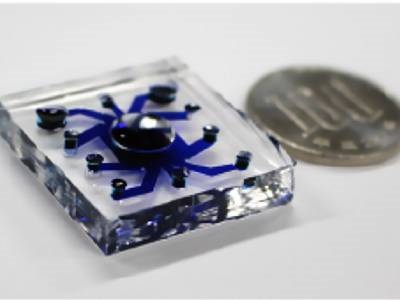
A team of scientists has developed an electrochemical sensing platform for studying in vitro vascular systems. The channels and reservoirs were visualized using blue ink. Credit: Hitoshi Shiku
Microphysical systems (MPSs), sometimes called organs-on-a-chip, provide valuable in vitro models for biological research and drug testing by closely mimicking the natural microenvironments of cells and tissues in the human body. Recent advancements in MPS technology include the incorporation of realistic, perfusable vascular networks with the 3D cultured cells, but tools for monitoring the function of these vascularized tissue models in real time remain limited. A team led by Tohoku University researchers recently developed a electrochemical sensing platform for MPSs with vascular flow, expanding opportunities for research and drug testing using more complex and accurate tissue models.
The researchers identified electrochemical sensors as ideal for monitoring cell functionality due to their low invasiveness, real-time detection capabilities and high sensitivity for in vitro culture platforms. However, electrochemical sensors are incompatible with microfluidic devices, making them difficult to integrate into MPS platforms that include vascular flow. The researchers engineered a novel open-topped MPS device consisting of two layers separated by a thin membrane. The upper layer is used for culturing the 3D-cultured cells and electrochemical sensing of oxygen metabolism, while the lower layer contains five microfluidic channels for culturing the vascular network.
The team first tested their platform’s ability to measure oxygen metabolism in vascularized tissue by using the platform with human lung fibroblast spheroids. The researchers further applied the sensing system to patient-derived cancer organoids to analyze changes in oxygen metabolism during administration of the drug bortezomib through the vascular network. The results showed the sensors were successfully integrated into the system and provided the desired accurate measurements. The real-time, non-invasive and sensitive measurements provided through the platform could allow for improved drug screening using in vitro vascular systems, in an integrated manner not previously possible using MPS devices. This research was published in Biosensors and Bioelectronics.
“We found that the platform could integrate a perfusable vascular network with 3D cultured cells, and the electrochemical sensor could detect the change in oxygen metabolism in quantitative, non-invasive and real-time manner,” said corresponding author Hitoshi Shiku. “Biosensors are very important tools to realize more physiological drug screening. Our research group has developed various sensors for the purpose. We continue to expand the detectable molecules to develop more robust and high-throughput sensors.”