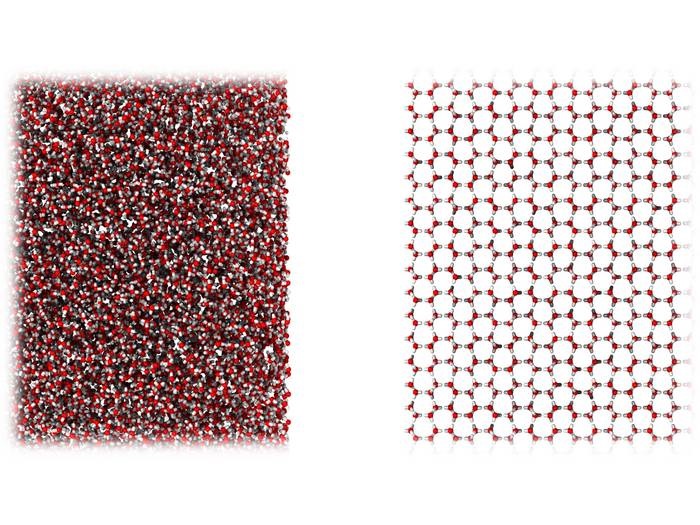
A new form of ice very similar in molecular structure to liquid water (left), compared to ordinary crystalline ice (right). Credit: University of Cambridge
Under ordinary conditions, water will freeze into crystalline ice, in which molecules are arranged in a regular pattern that differs significantly from the disorganized structure of liquid water. Amorphous ice, created under specific conditions, more closely resembles liquid water, but typically has either a higher density or lower density than its liquid counterpart. Now, a team at the University of Cambridge have produced a novel form of amorphous ice that provides researchers with a more accurate “snapshot” of liquid water and offers insights into its geophysical activity.
The researchers used a ball milling procedure to produce the new type of ice; this method is commonly used to produce other amorphous materials but had never been previously applied to ice. Ball milling crystalline ice under low temperatures produced a solid with both a similar density and similar molecular structure to liquid water. The product, called medium-density amorphous ice (MDA), fills the gap between the two major forms of amorphous ice previously discovered: high-density and low-density. To better understand the formation of MDA at the atomic level, the team used a computational simulation to mimic the repeated and random shearing of crystalline ice by ball-milling, creating a useful computational model of MDA.
Calorimetry experiments revealed a unique feature of MDA not found in other forms of ice; when recrystallizing into ordinary ice, it released an extraordinary amount of heat. In nature, it is possible that this recrystallization process could play a role in the activation of tectonic motions, suggesting that water could serve as high-energy geophysical material. The researchers believe MDA could be produced naturally, including in outer space – for example, it could be generated in the ice moons by tidal forces exerted by gas giants. This research was published in Science.
“Amorphous ice in general is said to be the most abundant form of water in the universe. The race is now on to understand how much of it is MDA and how geophysically active MDA is,” said lead author Angelos Michaelides.