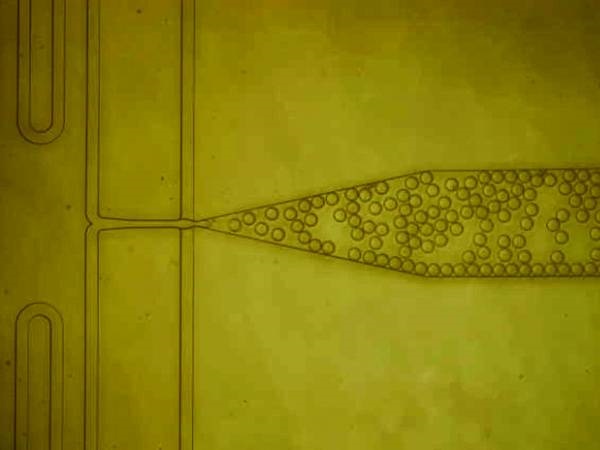
A microfluidic device was designed to combine protein solution with nanoparticles and then form thousands of tiny, identical droplets. Inside each of these droplets, the proteins interact with the nanoparticles, which help them to form protein crystals. Credit: MIT
Manufacturing protein-based drugs such as monoclonal antibodies and insulin requires these proteins to be purified from the bioreactors where they are produced. The conventional chromatography-based methods for protein purification in the pharmaceutical industry are highly cost-intensive, accounting for up to half the total cost of the protein manufacturing process. MIT researchers have developed a new nanoparticle technology that could greatly reduce the cost of protein purification, enabling the rapid crystallization of proteins on the engineered nanoparticle surface.
Protein crystallization processes, such as those used to prepare samples for X-ray diffraction, are generally too slow to be used in industrial processes like protein drug manufacturing. To speed up the crystallization process, the researchers designed the surface of gold nanoparticles to include the bioconjugates maleimide and N-hydroxysuccinimide ester (NHS). These bioconjugates, which are commonly used to tag proteins and attach them to drug-delivering nanoparticles, serve to encourage the accumulation of proteins on the nanoparticle surface. The incorporation of the bioconjugates also facilitates the arrangement of proteins into specific orientations to form a scaffold for additional proteins to readily join the forming crystal.
The team tested the ability of the nanoparticles to crystallize lysozyme and insulin, and observed up to a seven-fold reduction in induction time and three-fold increase in nucleation rate using the nanoparticles vs. control conditions with no nanoparticles. The bioconjugate-coated nanoparticles also performed much better than bare nanoparticles in speeding up protein crystallization. The nanoparticles also enhanced the crystallization of low concentrations of proteins, which is typically a challenge using conventional crystallization methods. In order to analyze the crystallization process on the nanoparticles, the team leveraged a novel machine learning algorithm to analyze thousands of microscope images of the crystals. This study was published in ACS Applied Materials & Interfaces.
“This is a general approach that could be scaled to other systems as well. If you know the protein structure that you’re trying to crystallize, you can then add the right bioconjugates that will force this process to happen,” said senior author Kripa Varanasi.
The researchers’ method could help reduce the cost of protein-based drugs, making them more affordable and accessible, especially in developing countries. The team is now working on scaling up the process so it can be used to purify proteins from industrial bioreactors.