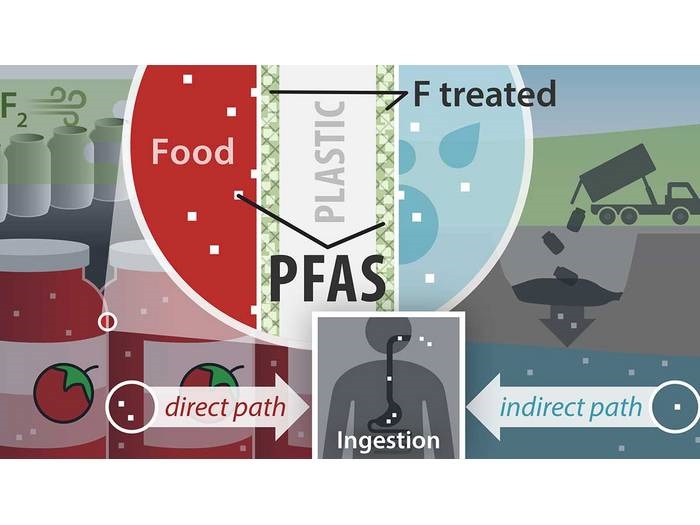
In a new study published in Environmental Science and Technology Letters, fluorinated high-density polyethylene (HDPE) plastic containers — used for household cleaners, pesticides, personal care products and, potentially, food packaging — tested positive for PFAS. Credit: University of Notre Dame
Fluorinated high-density polyethylene (F-HDPE) plastic containers are used for packaging or storage of a wide range of products, including household cleaners, pesticides, personal care items and food. Previous research has shown that F-HDPE containers can leach high amounts of per- and polyfluoroalkyl substances (PFAS) into pesticides, providing a potential indirect route for these “forever chemicals” to contaminate food. Now, researchers from the University of Notre Dame have uncovered a direct route of food contamination, finding that PFAS from F-HDPE containers can leach into various food matrices in concerning amounts.
The researchers tested the PFAS levels in F-HDPE and non-fluorinated HDPE containers, and also performed week-long leaching studies for various solvents and food matrices, using liquid chromatography-tandem mass spectrometry (LC-MS/MS) to measure the PFAS levels. The foods tested were olive oil, ketchup and mayonnaise, and the solvents tested were water, methanol and acetone. Additionally, the team studied the effect of temperature on the leaching of PFAS into food, performing leaching studies at both room temperature and 50°C.
The results showed that F-HDPE (but not non-fluorinated HPDE) containers carried significant levels of PFAS – approximately 63.75 ng per gram of plastic on average. Additionally, food and solvents stored in F-HDPE containers for seven days also showed higher levels of PFAS than samples not exposed to F-HDPE. PFAS concentrations in the solvents ranged from 0.99 to 66.92 ng/g plastic, while concentrations in the foods ranged from 2.66 to 7.19 ng/g plastic. The highest levels were measured in mayonnaise, and the lowest in olive oil. Notably, the researchers found concentrations of the PFAS perfluorooctane sulfonate (PFOA) in food that were higher than the limit set by the U.S. Environmental Protection Agency (EPA) in their 2022 Health Advisory Limits, said study co-author Graham Peaslee. In the elevated temperature conditions, the PFAS concentrations leached into the samples were more than eight times higher than under room temperature conditions. This research was published in Environmental Science & Technology Letters.
“Now, consider that not only do we know that the chemicals are migrating into the substances stored in them, but that the containers themselves work their way back into the environment through landfills,” Peaslee noted. “PFAS doesn’t degrade. It doesn’t go away. Once these chemicals are used, they get into the groundwater, they get into our biological systems, and they cause significant health problems.”
PFAS have been linked to health problems including prostate, kidney and testicular cancers, low birth weight, immunotoxicity and thyroid disease. The researchers estimated the PFAS that leached into the food would be equivalent to 0.77 to 2.68 ng/kg of body weight per week, posing a significant risk to those consuming food stored in these containers.