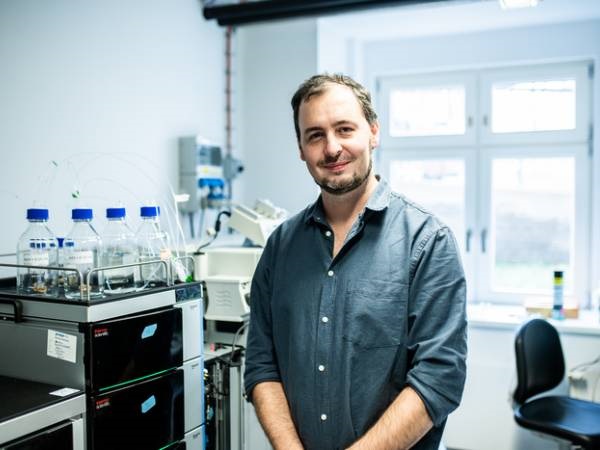
Tomáš Pluskal, group leader at IOCB Prague. Credit: IOCB Prague/Tomáš Belloň
Mass spectrometry (MS) experiments generate extremely large datasets, and analysts can face digital bottlenecks without powerful tools to process this data. MZmine is an open-source resource for processing MS data, which was developed by an international team of scientists and was first released in 2005. Now, the third generation of the MZmine, MZmine 3, has been made available with numerous improvements to streamline and accelerate MS data processing.
MZmine 2, the previous generation released in 2010, has been cited more than 2,200 times and enabled the analysis of hundreds of samples within a matter of days. MZmine 3 leverages improvements in memory management and parallelization, boosting throughput to thousands of samples per hour or more. Compared with MZmine 2, the newly-released software version reduced processing time by 89% for 250 dissolved organic matter samples, and also enabled the processing of more than 8,000 liquid chromatography (LC)-MS fecal samples in just 47 minutes, according to the paper published in Nature Biotechnology.
Additionally, MZmine 3 includes improved integrative workflows for ion mobility spectrometry(IMS)-MS imaging and LC-IMS-MS datasets, streamlining and enhancing multimodal analyses such as spatial metabolomics analyses. This enables increased confidence in annotations, without the need to utilize multiple, separate, specialized MS software tools, the authors wrote.
“MZmine has established itself as a trusted tool for mass spectrometry researchers over the past decade. Its modular framework has fostered community participation in the development of the MZmine code, leading to significant advancements featured in the newly released MZmine 3,” said co-first author Ansgar Korf, of the University of Münster.
The paper’s first authors are Korf, Robin Schmid, of the Institute of Organic Chemistry and Biochemistry of the Czech Academy of Sciences (IOCB Prague) and University of California (UC) San Diego, and Steffen Heuckeroth, also of the University of Münster. The corresponding author is Tomáš Pluskal, a group leader at IOCB Prague, who has served as the coordinator of the MZmine project almost since its inception. The paper is also co-authored by more than three dozen other contributors from around the globe.