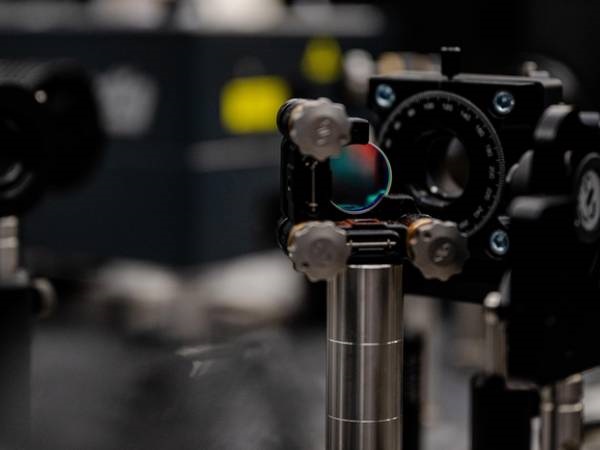
The study was only made possible by the new laser laboratories in the ZEMOS research building, where all external interference signals are minimized. Credit: Ruhr University Bochum, Marquard
Photo-induced excited-state proton transfer (ESPT) reactions are important in many chemical and biological processes, such as the fluorescence emission of certain dye molecules. Due to the extremely short timescale in which these reactions take place – in the order of picoseconds – precise details about how protons detach from one atom to transfer to another are difficult to uncover. Researchers from the Cluster of Excellence Ruhr Explores Solvation (RESOLV) at Ruhr University Bochum have used an advanced terahertz (THz) spectroscopy technique to gain new insights into the early stages of ESPT reactions between pyranine and water.
Pyranine is a photoacid fluorescent dye commonly used in yellow highlighters – it is also used in scientific applications, as a biological stain, pH indicator and more. In order to examine the picosecond-scale proton transfer between pyranine and water solvent, the researchers used optical pump THz probe (OPTP) spectroscopy. The combination of THz frequencies with the use of an optical pump enables the precise dynamics of chemical reactions to be elucidated with unprecedented time resolution. The custom OPTP spectrometer built by the team achieves a time resolution of 90 femtoseconds and can measure relative changes in electric field amplitude better than 5 x 10⁻⁵, according to the authors. The method enabled them to track minute fluctuations and nuclear rearrangements that take place during ESPT in less than a picosecond, specifically the changes that take place in the water solvent. The spectroscopic observations were also complemented by molecular dynamics simulations.
The advanced techniques enabled the researchers to observe oscillations lasting between three to five picoseconds that occur from “beating” between the solute and solvent prior to detachment of the proton. This motion transfers vibrational energy back and forth between the photo-excited pyranine and the water and results in a restructuring of water molecules around the photoacid, enabling proton migration. This rearrangement process occurs in less than a picosecond, making the energy transfer extremely efficient. While previous research on the ESPT reaction focused mainly on the photoacid solute, this study, published in Chemical Science, uncovers new insights into the response of bulk solvent reacting with the dye.
“It is exciting to see that the solvent response that promotes excited-state proton transfer could be caught in the act,” said corresponding author Martina Havenith.
The OPTP experiments were conducted at the new laser laboratories in the ZEMOS research building at Ruhr University Bochum. These facilities enable sensitive experiments to be protected from external interferences such as electromagnetic radiation and temperature and humidity fluctuations. The molecular dynamics simulations were conducted at the University of California at Berkeley by researchers belonging to CALSOLV, a sister institute of RESOLV.