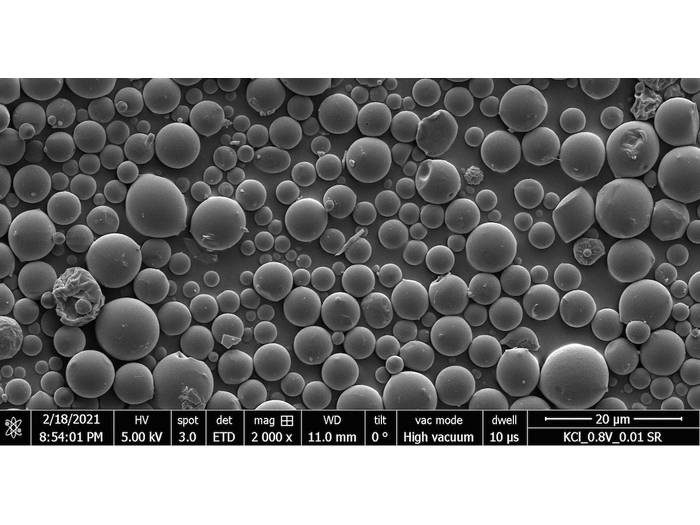
Scanning electron micrograph of biodegradable microparticles that reprogram immune cells to protect joints against inflammatory arthritis. Imaged at UC San Diego's Nano3 facility, Jacobs School of Engineering. Credit: David McBride, UC San Diego
All-trans retinoic acid (ATRA) is a small molecule that shows promise as a potential treatment for autoimmune diseases due to its ability to modulate pathogenic T cells. While currently approved by the FDA to treat acute promyelocytic leukemia, ATRA has not yet been developed as a treatment for other diseases such as autoimmune arthritis due to its immunosuppressant nature, potential off-target toxicity and other concerns. A team led by University of California San Diego researchers have designed a potential solution to current limitations of ATRA as a treatment for rheumatoid arthritis, using a biodegradable polymer system to enable a controlled release of the drug.
The new approach involves the use of microparticles based on poly-(lactic-co-glycolic) acid (PLGA). When microparticles containing ATRA are injected into joints, they stay contained within the joint area; direct injections to the affected area enables localized activity that has a lower risk of negative side effects than other methods of administration that cause ATRA to circulate throughout the body. As the polymer particles biodegrade, they release the ATRA in a sustained manner, allowing therapeutic concentrations to reach the joints over long periods of time without the need for frequent injections. This is important, as repeated injections can be harmful to the joints.
The researchers tested their PLGA-ATRA microparticle system on mouse and human cells, showing that ATRA promoted the differentiation of naive T cells into regulatory T cells, which reduce inflammation, while suppressing differentiation into inflammatory Th17 cells, even in conditions normally favoring Th17 cell differentiation. Experiments also confirmed the sustained release of ATRA from the microparticles over a 28-day period, and showed that ATRA retained bioactivity during that time. The system was further tested in mouse models for autoimmune arthritis; mice treated with ATRA showed less joint inflammation, cartilage damage and bone erosion as well as lower levels of Th17 cells in their joints and lymph nodes. Experiments also showed that the PLGA-ATRA system did not induce generalized immunosuppression in the mice. This study was published in the journal Advanced Science.
The team is now actively working toward commercialization of this potentially new treatment for rheumatoid arthritis, hoping to begin clinical trials within the next five years, according to first author David A. McBride. PLGA-ATRA could be a potential alternative for patients who do not respond well to disease-modifying anti-rheumatic drugs (DMARDs). Additionally, DMARDs are immunosuppressive, which poses risks such as susceptibility to infectious diseases and weaker responses to vaccines.
“In well controlled patients, reducing or eliminating the need for immunosuppressive drugs is desirable. However, when it is attempted, studies have shown that the disease can flare up again. So having a non-immunosuppressive option could go a long way,” said corresponding author Nisarg J. Shah.