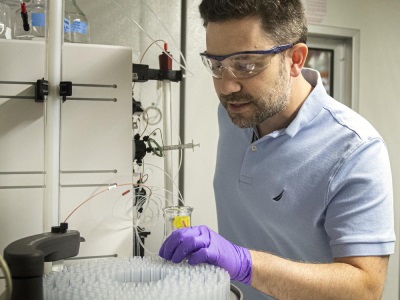
Credit: Patrick Mansell / Penn State
Scientists at Penn State University have discovered a new mechanism by which bacteria can selectively bind together and separate rare earth elements, creating new pathways for green tech. Rare earth elements are critical to almost all modern tech, and the methodologies presented could potentially create a more efficient and green alternative to separate these elements.
The study, published in Nature, proposes the use of the lanthanide-binding protein lanmodulin (LanM) as a potential alternative to solvent extraction-based separation of rare earth elements.
The researchers found that LanM, when bound to certain rare earth elements, can bind to itself creating a dimer while when bound to other elements it remains a monomer, creating an efficient way to separate rare earth elements. Rare earths, while relatively abundant, are not often found in high concentrations throughout the planet. Furthermore, these rare earth elements, namely the lanthanides, are of similar size and chemical behavior and are often found together in the earth's crust. Despite their similarities, they all have unique applications in technology and need to be separated. This separation step is often inefficient and relies on toxic chemicals, a problem the researchers feel they have potentially solved.
"There is getting them out of the rock, which is one part of the problem, but one for which many solutions exist," said Joseph Cotruvo Jr., associate professor of chemistry at Penn State. "But you run into a second problem once they are out, because you need to separate multiple rare earths from one another. This is the biggest and most interesting challenge, discriminating between the individual rare earths, because they are so alike. We've taken a natural protein, which we call lanmodulin or LanM, and engineered it to do just that."
Based on this work Penn State has filed a patent application, and the team of researchers are now attempting to fine-tune and streamline the process to work at scale, hoping to commercialize the process for industrial use.