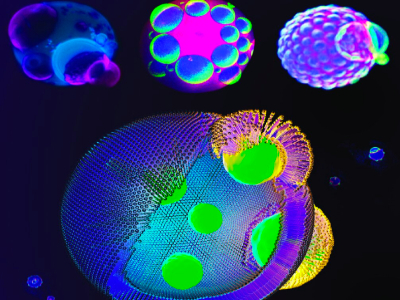
Credit: Wan-Chih Su, UC Davis
New research into physical interactions within a cell has revealed one possible explanation for how living cells manage their essential biochemistry. Researchers from the University of California, Davis recently published their work on membrane phase separation, shedding new light on the physical and chemical principles behind biology.
Eukaryotic cells contain organized structures called organelles that are bound by a lipid layer and perform a certain function, such as energy production in the case of mitochondria. Along with these standard organelles, molecules can cluster and create a form of temporary organelle that does not have a membrane to carry out a specific task within the cell.
Published in Nature Communications, the study aimed to better understand the physical mechanisms behind this temporary organelle formation. The researchers created artificial vesicles similar in size to a cell that contained a mixture of two polymers dissolved in water. What they discovered was that when they removed the water, the polymers parse into phase-separated droplets forming a mosaic of droplets instead of coming together into larger singular droplets.
The polymer interactions also seemed to have an effect on the outside of the cell as well, causing a bubbling effect. "Coupling to the cell boundary prematurely stops phase separation and creates a mosaic of droplets. These 3D droplets inside the vesicle, interestingly, reorganize molecules in the 2D membrane, thus also signaling to the outside of the vesicle," said Atul Parikh, professor of biomedical engineering at the University of California, Davis
The researchers believe that this physical interaction of polymers within a cell is applicable to all cells and not just this specific combination of molecules used for the study. They intend to further their research into physical interactions within living cells and other complex systems.