Credit: Li Lab/UCLA
Researchers at the California NanoSystems Institute at UCLA recently published research into lithium that could lead to safer lithium-metal batteries that perform better than the lithium-ion batteries used today. By discovering the true shape of lithium, the findings suggest that the risk of explosion in lithium-metal batteries could be reduced.
Metallic lithium is very reactive and under normal conditions corrodes rapidly, almost immediately after being applied to a surface such as an electrode. In traditional lithium battery technology, the lithium forms branching filaments with protrusions, which when crossed can short-circuit and lead to explosions. In the study, published in Nature, the researchers discovered that by applying lithium faster than corrosion can form the lithium atoms will accumulate in a more orderly fashion than the criss-cross branching of corroded lithium.
“We wanted to see if we could deposit lithium so quickly that we outpace the reaction that causes the corrosion film,” said UCLA doctoral student Xintong Yuan, the study’s first author. “That way, we could potentially see how the lithium wants to grow in the absence of that film.”
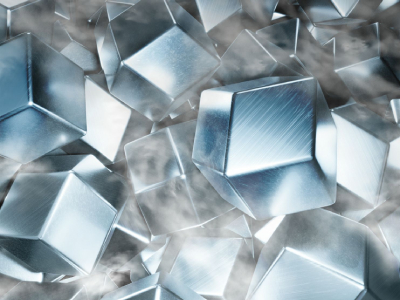
They discovered that in the absence of corrosion film, lithium atoms assemble themselves into an orderly rhombic dodecahedron. “There are thousands of papers on lithium metal, and most descriptions of the structure is qualitative, such as ‘chunky’ or ‘column-like,’” said Yuzhang Li, an assistant professor of chemical and biomolecular engineering at UCLA. “It was surprising for us to discover that when we prevented surface corrosion, instead of these ill-defined shapes, we saw a singular polyhedron that matches theoretical predictions based on the metal’s crystal structure. Ultimately, this study allows us to revise how we understand lithium-metal batteries.”
The researchers utilized cryo-electron microscopy, or cryo-EM, to visualize the shape of the corrosion-free lithium. When comparing their results to standard techniques, the researchers found that in all instances their method produced dodecahedrons in all four trials. The development of a method to produce lithium-metal batteries using these findings presents significant implications for the improvement of high-performance energy technology as lithium-metal batteries can store nearly double the energy of commonly used lithium-ion batteries.