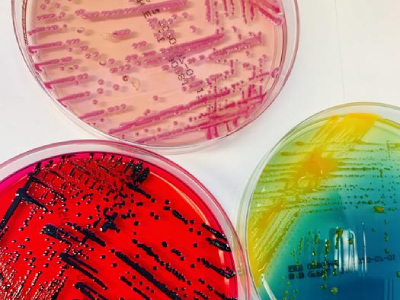
Growth of bacterial cultures in Petri dishes. Credit: Sylvia Suter, University Hospital Basel
University of Basel researchers have discovered over thirty new species of bacteria, a few of which are associated with several clinically relevant infections. The findings result from a multi-year effort to collect and identify unknown bacteria that occur in hospitals.
Unknown bacteria are not uncommon within hospital systems and often their identification can lead to more accurate treatment of bacterial infections. Since 2014 researchers from the University of Basel and the University Hospital Basel have been collecting and analyzing samples containing unknown bacteria in hopes of identifying them.
In the study, published in BMC Microbiology, researchers analyzed more than 60 unknown bacteria found in blood or tissue samples within the hospital system, leading to the discovery of 35 unknown bacteria. Of the 35 unknown bacteria, seven of the strains were clinically relevant. “Such direct links between newly identified species of bacteria and their clinical relevance have rarely been published in the past,” said Dr. Daniel Goldenberger.
Most of the newly discovered bacteria belonged to the Corynebacterium and Schaalia genera. “Many species in these two genera are found in the natural human skin microbiome and the mucosa. This is why they are frequently underestimated, and research into them is sparse,” added Goldenberger.
The researchers intend to continue their systematic collection and subsequent sequencing of unknown pathogens in the hospital system. To date, the researchers have already identified more than twenty additional unknown species. “We have noticed a major dynamic here: thanks to technological advances in bacteriology, much more is being published about newly discovered species of bacteria,” said Goldenberger
Analysis and identification of these unknown species will improve diagnosis accuracy and subsequent treatment strategies for rare pathogens in the future.