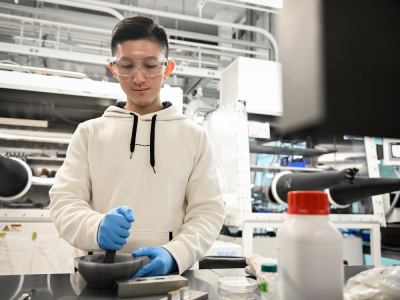
Po-Hao Lai prepares a sample for cold sintering, where he blends, grinds and moistens the material after the addition of a transient solvent. Credit: Poornima Tomy/Penn State
Researchers from Penn State have recently published their findings outlining 3 potential new uses for cold sintering to advance recycling capabilities by allowing a material to be repeatedly recycled. First developed in 2016, cold sintering is a process that combines powder-based materials with a solvent before applying pressure to form a material that can be continually recycled.
Traditional recycling methods have many drawbacks and limitations including the type of plastic that can be recycled. Additionally, most recycling methods lead to downcycling, a process in which the material's characteristics degrade with each recycling cycle, reducing the material's beneficial characteristics. In the research, published in Materials Horizons, the team developed a novel sintering method to produce a construction-grade composite material by combining ceramic with polypropylene.
“Cold sintering plastic with ceramic materials produces strong, tough composites perfect for use in construction,” said Po-Hao Lai, a doctoral student in chemical engineering. “These composites can undergo multiple recycling cycles with only the addition of water, offering lower energy and water demands compared to conventional construction materials.”
Additionally, the team also developed and published a novel method using cold sintering to recycle the solid and liquid electrolytes of a solid-state battery. Published in ChemSusChem, the method provides a means to reprocess and reuse battery electrolytes, reducing the energy consumption and environmental impact of their production.
Their last method, published in MRS Communications, utilizes cold sintering to form a composite necessary for the construction of capacitors used in electric vehicles.
“Our work in MRS Communications demonstrates the potential for recycling materials that will be crucial for the electrification of transportation, and therefore the reduction of greenhouse gases,” said Hongtao Sun, assistant professor of industrial and manufacturing engineering
Cold sintering is still in its infancy, but despite its relatively recent invention the research performed by the team at Penn State demonstrates the adaptability of cold sintering to solve some of the world's most challenging recycling issues.
"We are now seeing many other research groups adopt the cold sintering process all over the world in universities, national labs and even within industry," said Clive Randall, director of Penn State’s Materials Research Institute. "I have been amazed by the diversity of applications that are emerging, but the research in the Gomez Group establishes a path for a circular economy, an extremely important strategy that is required for a sustainable future."