Credit: Tony Z. Scott et al.
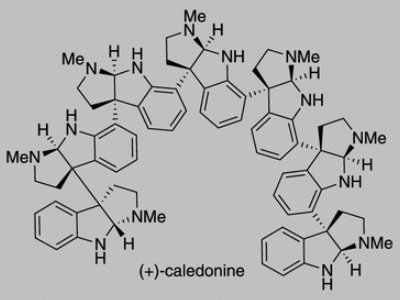
Chemists from MIT have developed a novel system to synthesize complex molecules known as oligocyclotryptamines.
Oligocyclotryptamines are complex compounds originally isolated from plants that demonstrate potential for use in an array of pharmaceutical products including antibiotics, analgesics, or cancer drugs. While promising, only small quantities of oligocyclotryptamines are naturally available.
To overcome this lack of availability, MIT chemists developed a method, published in the Journal of the American Chemical Society, to add tryptamine-derived components one at a time to molecules. This approach allows the team to precisely assemble the rinds and control the orientation of the final product.
"For many of these compounds, there hasn't been enough material to do a thorough review of their potential. I'm hopeful that having access to these compounds in a reliable way will enable us to do further studies," says Mohammad Movassaghi, an MIT professor of chemistry.
Using the method, the researchers were able to synthesize oligocyclotryptamines at quantities they believe could be used to investigate their potential therapeutic activity thoroughly. Additionally, the technique can be modified and optimized to create novel compounds by substituting different cyclotryptamine subunits.
"We will continue to use this very precise way of adding these cyclotryptamine units to assemble them together into complex systems that have not been addressed yet, including derivatives that could potentially have improved properties," added Movassaghi.