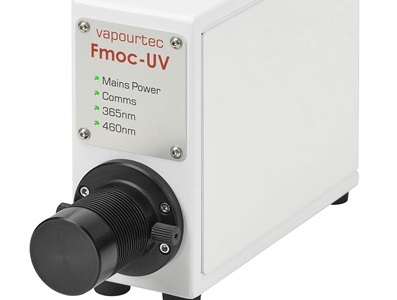
Vapourtec has developed an online UV detector designed specifically for peptide synthesis and flow chemistry applications. Rugged, reliable and compact, the Fmoc-UV has no moving parts and features a low-cost flow cell that can be easily replaced in the event of any blockages.
The Fmoc-UV has been designed to quantify the amount of the fluorenylmethoxycarbonyl (Fmoc) protecting group in the outflow during peptide synthesis (SPPS) and analyses two wavelengths (365nm and 460nm) at a high acquisition rate of 4 Hz. The 365nm wavelength is aimed at quantifying Fmoc following deprotection of the standard protection group whilst the 460nm wavelength is ideal for 4-Methyltrityl (Mtt) group which is commonly used during the construction of side chains in the synthesis of APIs (active pharmaceutical ingredients) such as Semaglutide and others.
Most UV detectors are designed for the low concentration and relatively non-corrosive solutions used in HPLC applications. Flow chemistry applications, by contrast, require the use of corrosive reagents, often at high concentrations.
Designed for peptide synthesis, the Fmoc-UV is suitable for other applications in both flow and batch chemistry environments where users can easily perform online sampling of batch reactors.
Other key features of the Fmoc-UV include serial communication via RS232 protocols and the ability to interface directly with Vapourtec’s R-Series software.