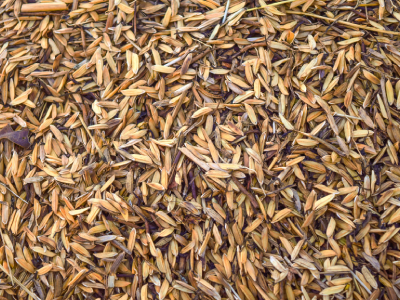
Researchers from the University of Michigan have discovered a source of carbon that could double the energy density of lithium-ion and sodium-ion batteries in the ash of burned rice hulls.
Published in the journal Advanced Sustainable Systems, this is the first time researchers have demonstrated that hard carbon can be made through normal combustion. Previously, it was believed that hard carbon could only be made by heating biomass over 2200°F in an oxygen-free environment. The method presented represents a significant step towards improving battery sustainability by offering an alternative to importing graphite from China or Mexico.
The hard carbon discovery comes on the heels of previous research by the team in which they developed a method to produce high-purity silicon from rice hull ash. During that research, the team noted that the remaining ash was 60%-70% carbon but believed it to be amorphous carbon. After investigating this carbon spectroscopically though, the team discovered nanoscale islands of graphite within the carbon matrix, a mixture otherwise known as hard carbon.
"Hard carbon can be produced by combustion in this case because as you burn away the carbon of rice hulls, you create a shell of silica around the remaining carbon and it bakes it like a pie," said Richard Laine, U-M professor of materials science and engineering and macromolecular science and engineering.
when the team tested the electrochemical properties of the rice hull hard carbon, it outperformed the commercial hard carbon as well as graphite when used as a lithium-ion battery anode.
With the assistance of U-M Innovation Partnerships, the team has applied for patent protection and is actively seeking partners to commercialize the tech.