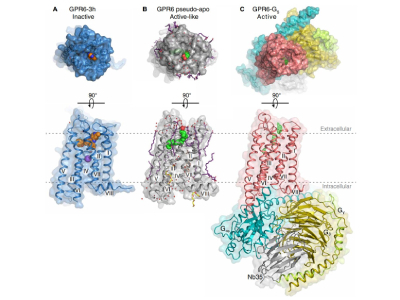
Top and side views of GPR6 structures in different conformational states. Credit: Science Signaling (2024). DOI: 10.1126/scisignal.ado8741
Researchers led by the University of Southern California have revealed structural details of the GPR6 brain receptor which could lead to novel Parkinson’s disease treatments.
Characterized by the degeneration of dopamine-producing neurons within the substantia nigra pars compacta, Parkinson’s disease leads to dopamine depletion and motor symptoms such as muscle stiffness and tremors. Current treatments for the disease are limited to symptomatic relief and their long-term use has diminishing returns and can even lead to complications.
GPR6 inhibition represents an alternative therapeutic strategy that may address symptoms without the side effects of current treatments. In the research, published in Science Signaling, researchers employed advanced imaging techniques such as cryo-EM to resolve the structure of GPR6 in different states. Additionally, the team examined how the receptor interacts with drugs that could be used to reduce its activity.
Ultimately, the experiments revealed a lipid-like molecule that stabilizes an active-like conformation of GPR6 in a fully active GPR6-Gs protein complex. The findings suggest that endogenous lipids could play a role in GPR6 activity and provide a framework for a structure-based drug design to improve Parkinson's disease treatment.