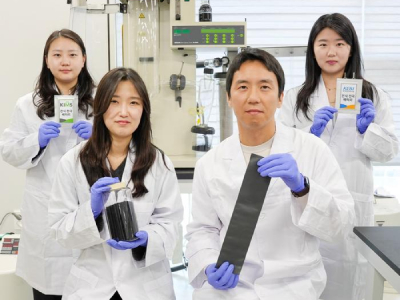
(Front row, left) Senior Researcher Jihee Yoon from KIMS and (Front row, right) Senior Researcher Insung Hwang from KERI successfully manufactured dry electrodes for high-capacity secondary batteries using the spray drying technique. Credit: Korea Electrotechnology Research Institute
Scientists from the Korea Electrotechnology Research Institute (KERI) and the Korea Institute of Materials Science (KIMS) have developed a novel 'spray drying' technique which can achieve a uniform mixture of materials, additives, and binders for use in secondary battery electrode manufacturing.
To achieve uniformity in mixing, the method requires mixing the materials in a liquid slurry before spraying the mix into a high-temperature chamber which rapidly evaporates the solvents used. The resulting composite powder can then be transformed into high-capacity electrodes through various ‘dry-electrode processes’.
The collaborative team from KERI and KIMS believe that the development of the method will provide a clear path towards high capacity in secondary batteries. Thanks to the effective mixing between the internal materials and the reduction in necessary additives, the method provides a means for increasing the amount of active materials used which will have a positive impact in battery capacity.
The work performed by the team holds the potential to advance next generation batteries such as solid-state and lithium-sulfur batteries. "Through follow-up research, we plan to reduce process costs, improve mass production capabilities, and increase technology maturity, with the goal of eventually transferring the technology to companies," concluded Senior Researcher Jihee Yoon from KIMS' Convergence and Composite Materials Research Division.