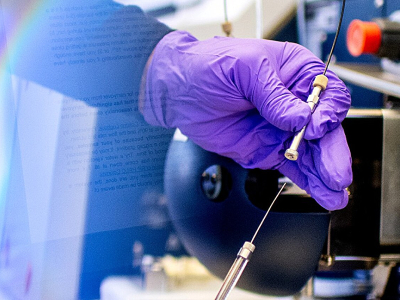
Northeastern professor Jeffrey Agar helped develop a free model and "decision tree" that even small labs can use to pursue drug discovery. Credit: Matthew Modoono/Northeastern University
Recent popularity of antivirals such as Paxlovid have caused an explosion in research interest of covalent drugs. Thanks to permanent bonds formed with target proteins, this class of drugs is longer-lasting with higher potential potency than their non-covalent counterparts. While some covalent drugs have been around for some time, discovery of the next generation of drugs has been limited by false positives during discovery and a lack of in vivo efficacy measurements.
Described in their recent work, published in Nature Communications, the team developed a novel mathematical and bioanalytical model which employs mass spectrometry and protein analysis to develop a “decision tree” which can determine a new drugs potential efficacy.
"We try to keep it as simple as possible," said Jeffrey Agar, associate professor of chemistry and pharmaceutical sciences at Northeastern. "Now that we've done it, you don't ever have to do it again. Take the number that you got and put it into this equation."
Using only a single drop of blood, the system measures how much of the drug is bound to the target protein, revealing significantly more information than simply confirming the presence of the drug.
The newly developed model and associated decision tree will allow labs, regardless of their size, to expedite the early stages of drug discovery. Additionally, the researchers intend to make the technique free, with a goal to increase availability for even the smallest labs as part of an effort to increase the “democratization of science" according to Agar. "We decided not to patent this," he added. "Just take it, use it and make drugs safer."