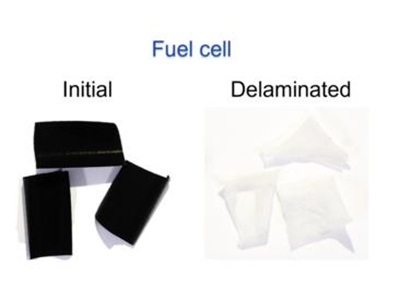
High-power ultrasound rapidly separates valuable catalyst from underlying polymer membranes in under a minute. Credit: University of Leicester
Researchers at the University of Leicester have achieved a major milestone in fuel cell recycling, using soundwaves to efficiently separate valuable catalyst materials and fluorinated polymer membranes (PFAS) from catalyst-coated membranes (CCMs).
Fuel cells and water electrolyzers, essential components of hydrogen-powered energy systems, powering cars, trains and buses, depend on CCMs containing precious platinum group metals. However, the strong adhesion between catalyst layers and PFAS membranes has made recycling difficult.
This new scalable method uses organic solvent soaking and water ultrasonication to effectively separate the materials.
“Fuel cells have been heralded for a long time as the breakthrough technology for clean energy but the high cost of platinum group metals has been seen as a limitation. A circular economy in these metals will bring this breakthough technology one step closer to reality,” said Jake Yang from the University of Leicester School of Chemistry.
Building on this success, a follow-up study introduced a continuous delamination process, using a bespoke blade sonotrode that uses high-frequency ultrasound to split the membranes to accelerate recycling. The process creates bubbles that collapse when subjected to high pressure, meaning the precious catalysts can be separated in seconds at room temperature. The innovative process is both sustainable and economically viable, paving the way for widespread adoption.
As fuel cell demand continues to grow, this breakthrough contributes to the circular economy by enabling efficient recycling of essential clean energy components.