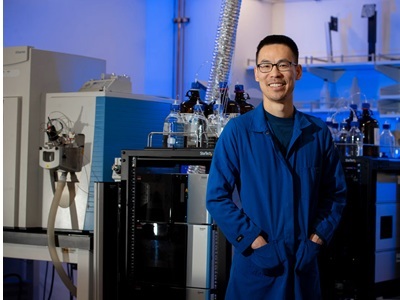
UCR computer scientist Mingxun Wang in his laboratory. Wang created the new programming language for scientists. (Stan Lim/UCR)
Researchers at UC Riverside have developed a new programming language that enables scientists to rapidly uncover previously unknown environmental pollutants—without knowing how to code.
Mass Query Language—or MassQL—functions like a search engine for mass spectrometry data, enabling researchers to find patterns that would otherwise require advanced programming skills.
“We wanted to give chemists and biologists, who are generally not also computer scientists, the ability to mine their data exactly how they want to, without having to spend months or years learning to code,” said Mingxun Wang, UCR assistant professor of computer science, who created the language.
As described in a Nature Methods article, the UCR teamused MassQL to sift through all publicly available mass spectrometry data on water samples looking for organophosphate esters, which are generally found in flame retardants. In addition to finding known chemicals in the water samples, the model also found organophosphate compounds that have not been previously described or catalogued, and some chemicals that are the product of organophosphates breaking down over time.
“There are quite literally a billion measurements of molecules in this data. You cannot go through it manually,” said Wang. “However, the language acts like a filter, in a sense, for these chemicals, and it pulled out thousands of them.”
The research team also wanted to demonstrate that the language could be useful in a variety of real-life situations. In addition to the flame retardants project, the paper details more than 30 applications in which MassQL could be applied. Sample-use cases include the detection of fatty acids as markers of alcohol poisoning, looking for new drugs to solve the looming antibiotic resistance crisis, learning about the chemicals that bacteria use to communicate with one another, and finding PFAS on playgrounds.
Information provided by UCR