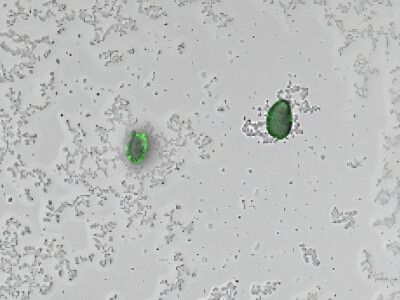
Engineered microbes produce bioluminescence in the presence of microplastics, creating a living sensor seen here as a detectable green fluorescence signal, which is laid over a scanning electron microscope image. Credit: Song Lin Chua
Researchers have developed a novel “living sensor” which, after attaching to microplastics in a sample, produce a green fluorescence. Tested in real-world water samples, the unique biosensor was able to easily detect microplastic contamination.
Current microplastic detection options typically include microscopy or spectroscopy techniques, which while accurate, require time consuming preparation time and costly analysis. To simplify microplastic detection, the team created a living sensor using Pseudomonas aeruginosa, a bacterium commonly found in the environment.
Published in the journal ACS Sensors, the work included an addition of two genes to a non-infectious laboratory strain of P. aeruginosa, one which activates when in contact with plastic and another which produces the green fluorescence.
Lab testing of the sensor demonstrated a measurable fluorescence within three hours of contact with polyethylene terephthalate and polystyrene. Additionally, the sensors remained active for up to 3 days while refrigerated.
In a real-world demonstration of the biosensor, the team added the engineered P. aeruginosa to a seawater sample which had first been filtered to remove organic matter. The team concluded that based on fluorescence intensity the water contained up to 100ppm of microplastics, which were later identified using Raman microspectroscopy as biodegradable types.
"Our biosensor offers a fast, affordable and sensitive way to detect microplastics in environmental samples within hours," said Song Lin Chua. "By acting as a rapid screening tool, it could transform large-scale monitoring efforts and help pinpoint pollution hotspots for more detailed analysis."