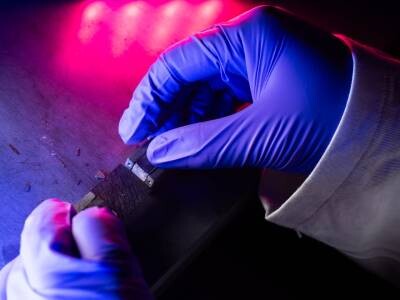
A team of researchers including Rice University's James Tour and Shichen Xu has developed an ultrafast, one-step method to recover rare earth elements (REEs) from discarded magnets using an innovative approach that offers significant environmental and economic benefits over traditional recycling methods. Credit: Jeff Fitlow/Rice University.
Rice University researchers have published their novel method which offers an ultrafast, single step process to recover rare earth elements (REEs) from discarded magnets. The innovative approach offers not only environmental, but also economic benefits over traditional recycling methods.
Traditional recycling methodology is resource intensive and produces toxic waste in the process. To remedy this, the new method developed by the Rice researchers uses flash Joule heating (FJH) to rapidly raise the material temperature before extracting the REEs using chlorine gas in seconds. The method, which is fully described in a recent publication in the Proceedings of the National Academy of Sciences, does not require water or acids for REE recovery.
"We've demonstrated that we can recover rare earth elements from electronic waste in seconds with minimal environmental footprint," said James Tour, Professor of Chemistry, materials science, and nanoengineering. "It's the kind of leap forward we need to secure a resilient and circular supply chain."
"This method not only works in tiny fractions of the time compared to traditional routes, but it also avoids any use of water or acid, something that wasn't thought possible until now," added Shichen Xu, a postdoctoral associate at Rice.
The method can be used to create easy to use recycling units which can be placed closer to the point of recycling, leading to local systems which can quickly and cleanly process used magnets.
"The results show that this is more than an academic exercise—it's a viable industrial pathway," Tour concluded.