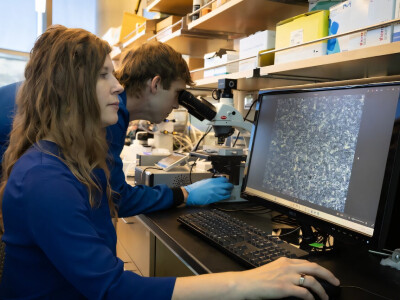
Jessica Kramer, left, and Thomas McParlton observe the size of ice crystals in a sample treated with their protein in their lab at the University of Utah. Credit: Dan Hixson, University of Utah
University of Utah researchers have devised a unique way to make a stripped down, synthetic version of the protein which prevents fish from freezing in polar waters to prevent the formation of ice crystals in food and drugs.
Described in a recent publication in the journal Advanced Materials, the method builds on previous research which outlined which structural features were most critical in these natural “antifreeze” proteins.
"Ultimately, we simplified the structure to only the parts we thought were required for antifreeze activity, which makes production less complicated and expensive," said Jessica Kramer, an associate professor in the Department of Biomedical Engineering at the University of Utah. "Despite those changes, this study showed that our mimics bind to the surface of ice crystals and inhibit crystal growth, just like natural antifreeze proteins."
"Best of all," Thomas McParlton added, "we make these mimics entirely using chemistry—no fish or cells required."
To demonstrate the efficacy of the method, the team tested their mimic polypeptides on real world test cases including ice cream and the anti-cancer drug Trastuzumab. During their analysis, the team were able to successfully chill the ice cream to -4°F and Trastuzumab down to -323°F.
The duo envisions the mimic polypeptides being used in several applications ranging from extending the shelf life of food to improving how we store and transport life-saving biologics. The tech is currently patent pending, and the team is working to bring it to market through a new startup called Lontra Bio LLC.