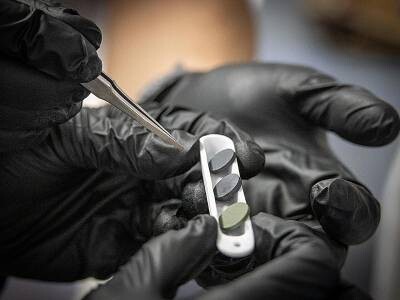
Three of the seven newly synthesized high-entropy oxide ceramic pellets are pictured here. Credit: David Kubarek / Penn State
Researchers from Penn State have created seven new high-entropy oxides (HEOS) by removing oxygen during synthesis. HEOS are a class of ceramics composed over more than five metals and have widespread potential applications in energy storage and other next gen technologies.
Described in the journal Nature Communications, the researchers used the principles of future materials to develop a novel framework in the process of synthesizing the novel HEOS ceramics.
"By carefully removing oxygen from the atmosphere of the tube furnace during synthesis, we stabilized two metals, iron and manganese, into the ceramics that would not otherwise stabilize in the ambient atmosphere," said Saeed Almishal, research professor at Penn State.
After first finding success stabilizing a manganese and iron containing material dubbed J52, Almishal then utilized machine learning to screen thousands of compositions ultimately identifying six other combinations of metals forming HEOs. Once identified, Almishal successfully synthesized bulk ceramic pellets of the seven stable, potentially functional HEOs.
"In a single step, we stabilized all seven compositions that are possible given our current framework," Almishal added. "Although this was previously treated as a complex problem in the field of HEOs, the solution was simple in the end. With a careful understanding of the fundamentals of material and ceramic synthesis science—and particularly the principles of thermodynamics—we found the answer."
The team intend to expand on their work by further testing the seven new materials, while applying their thermodynamic framework to other material classes in search of other currently unstable materials to synthesize.