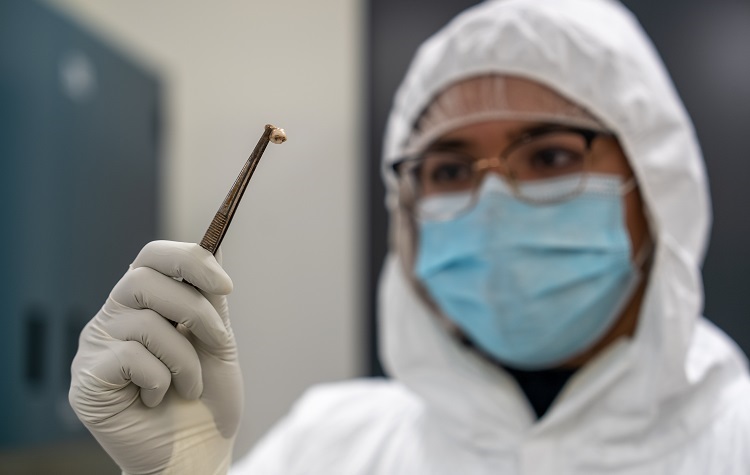
Using DNA extracted from teeth of people who died before, during and during the Black Death pandemic, researchers were able to identify genetic differences that dictated who survived and who died from the virus. Credit: Matt Clarke/McMaster University
Has COVID-19 altered the human genome? From the beginning of the pandemic, scientists have been investigating long-COVID and its myriad of physical and neurological symptoms. But, has COVID-19 caused changes even deeper than exhaustion and brain fog?
If COVID-19 takes after the Black Death, then the answer is most likely yes.
In a new study, analyzing DNA as old as the 1300s, an international research team identified key genetic differences that determined who lived and who died during the Black Death—and showed how those genetic variants continue to affect human susceptibility to modern disease.
For example, the same genes that once conferred protection against the Black Death are today associated with an increased susceptibility to autoimmune diseases, such as Crohn’s disease and rheumatoid arthritis.
For the study, researchers from McMaster University, the University of Chicago and the Pasteur Institute in France focused on a 100-year window before, during and after the Black Death, which reached London in the mid-1300s. They extracted more than 500 ancient DNA samples from the bones of over 200 individuals from Denmark and London, including individuals buried in the East Smithfield plague pits used for mass burials in 1348 and 1349.
Using targeted sequencing for a set of 300 immune-related genes, the scientists identified four genes that were under selection, all of which are involved in the production of proteins that defend the immune system from invading pathogens. Depending on the variant, the genes either protected against or increased susceptibility to Yersinia pestis.
The researchers zeroed in on the gene ERAP2, which plays a role in helping the immune system recognize the presence of an infection. According to the study published in Nature, individuals who possessed two copies of one specific genetic variant—dubbed rs2549794—were able to produce full length copies of the ERAP2 transcript, compared with another variant that led to a truncated and non-functional version of the transcript.
The team estimates that Europeans with the rs2549794 variant were 40 to 50 percent more likely to survive the Black Death than their counterparts.
“The selective advantage associated with the loci are among the strongest ever reported in humans, showing how a single pathogen can have a strong impact on the evolution of the immune system,” said study author Luis Barreiro, professor of genetic medicine at the University of Chicago.
But, fast-forward 700 years, and that impact is not necessarily positive any longer.
Investigating further, the team found that while ERAP2 was indeed protective against the Black Death, in modern populations, it is now associated with increased susceptibility to autoimmune diseases—including acting as a known risk factor for Crohn’s disease.
“These genes are under balancing selection—what provided tremendous protection during hundreds of years of plague epidemics has turned out to be autoimmune related now. A hyperactive immune system may have been great in the past, but in the environment today it might not be as helpful,” said co-senior author of the study Hendrik Poinar, professor of anthropology at McMaster University.
In the future, the researchers plan to scale the project to examine the entire genome, not just a selected set of immune-related genes. They said they hope to explore genetic variants that affect susceptibility to bacteria in modern humans, comparing the variants to the ancient DNA samples to determine if they are also a result of natural selection.
“Understanding the dynamics that have shaped the human immune system is key to understanding how past pandemics, like the plague, contribute to our susceptibility to disease in modern times,” said study author Hendrik Poinar, director of McMaster’s Ancient DNA Centre.
But the question remains: In 2720, will scientists discover COVID-19-related genetic variants in our DNA that are making our descendants more susceptible to modern illnesses?