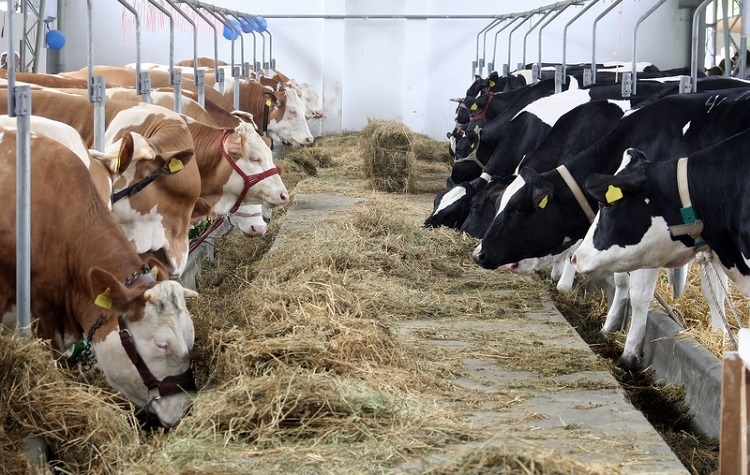
Excessive use of antibiotics continues to worsen antimicrobial resistance at a worldwide level. In the United States, industrial food animal production is one of the most powerful drivers of antibiotic use. In fact, 70 percent of antibiotics are sold for use in livestock.
In an attempt to reduce antimicrobial resistance (AMR) and health impacts, the state of California passed Senate Bill 27 in 2018. The bill bans—for the first time in the U.S.—routine preventive use of antibiotics in food-animal production and any antibiotic use without a veterinarian’s prescription.
In a new study, a diverse team of researchers led by Columbia University/University of Washington’s Joan Casey evaluated the effects—if any—of the bill three years after it was passed. Encouragingly, the team concluded Senate Bill 27 was associated with a 7% reduction in resistance in humans to one class of antibiotics used in livestock.
For the study, published in Environmental Health Perspectives, the research team analyzed antibiotic-resistant E. coli in 7.1 million urine samples taken from people with urinary tract infections across 33 states from 2013 to 2021.
The study used the augmented synthetic control method (ASCM) to compare California with other states that did not pass such legislation. The researchers constructed a “synthetic California” based on a composite of other states without the policy change, and then contrasted its counterfactual post-policy trends with the observed post-policy trends in California.
“In an ideal world, we'd have two California’s and we would observe both of them over time,” said Casey. “Instead, we used statistical methods to create this dream, synthetic California in which the bill had not been passed. By comparing the estimated outcomes of the synthetic California in the post-SB27 period with California’s post-SB27 implementation outcomes, we were able to estimate the effect of SB27 on E. coli resistance in California.”
The team honed in on four different antibiotic-resistant E. coli— aminoglycosides, ESC, fluoroquinolones and tetracyclines. According to the study results, from 2013 to 2017, the median resistance percentages in California were 11.9%, 13.8%, 24.6% and 7.9%, respectively. Post-SB27, the researchers did not see any change in resistance to aminoglycosides, fluoroquinolones or tetracyclines. However, SB27 was associated with a 7.1% reduction in ESC resistance.
That class—extended-spectrum cephalosporins—is used in raising both cattle and poultry. Though it represents less than 1% of U.S. antibiotic sales for livestock, 80% of the sales are for use in cattle, one of the most common food animals raised in California.
Tetracycline is used in both livestock and humans, while the other two antibiotics studied, aminoglycoside and fluoroquinolones, are used only in humans.
While the researchers were able to devise a statistical method that worked, they said interpreting the results was complicated by the fact that California has not made data for on-farm antibiotic use public—despite that being a tenant of SB27.
“California’s Department of Food and Agriculture hasn’t made data available in a way that allows the public to determine whether the implementation of SB27 has led to a reduction in on-farm antibiotic use,” said Keeve Nachman, associate professor of environmental health engineering at Johns Hopkins University. “As a workaround, we leveraged a novel statistical technique to begin to assess the impact of the law on an infection with a large public health burden.”
Casey, Nachman and colleagues are now extending their research to include whole-genome sequencing of E. coli isolated from human urine as well as retail chicken meat in California in order to help complete the picture they have already painted.
“Generally, what we see is an increasing upward trend in antimicrobial resistance,” said Casey. “Policies that lead to a leveling off or a decline in this resistance are promising. A 7% reduction—for a bill where we aren’t sure about its implementation quality—is pretty exciting. I'm hopeful that this can spur other states to consider similar bills.”
At the state level, only Maryland has antibiotic overuse legislation similar to California’s.