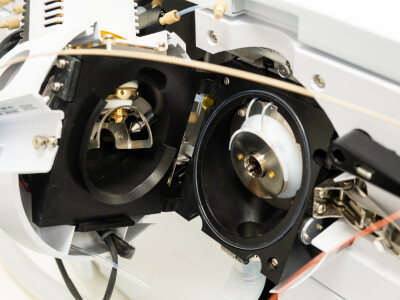
Leiden University researchers have developed a novel mass spectrometry method capable of screening hundreds of thousands of molecules for drug discovery, offering a quick, more accessible alternative to traditional DNA tag methodology.
Published in the journal Nature Communications, the mass spec method offers more flexibility when searching for promising drug candidates without needing DNA barcodes.
"In drug discovery, you usually start with a huge collection of molecules and hope that one of them sticks to your target protein," explains Sebastian Pomplun. "Traditionally, pharmaceutical companies test these molecules one by one in enormous robotic facilities, so-called high throughput screening. It's effective, but it's also incredibly expensive and slow."
Recent decades have seen a shift towards DNA-encoded libraries (DELs) for drug candidate screening. "It's a brilliant technology," added Pomplun, "but it also has some big drawbacks." DNA tags are bulky and often block molecules from binding properly. The tags also limit what chemical reactions can be used during the process. "We thought, what if we could do the same kind of screening, but without the DNA at all?"
To build the mass spec method, the team designed chemical libraries which contain hundreds of thousands of compounds, each built with slightly different molecular building blocks. When mixed with a target protein, the compounds which stick are isolated and analyzed with mass spectrometry.
"It's like each molecule leaves behind a unique fingerprint," Pomplun explains. "Even if two compounds have the same mass, the way they fragment tells us which is which."
The team hopes their novel "self-encoded" approach will make drug discovery more accessible beyond big pharma companies. "With our method, academic labs could also more easily take part in early-stage drug discovery," Pomplun concluded. "It's faster, simpler, and opens the door to exploring new kinds of molecules that we couldn't study before."