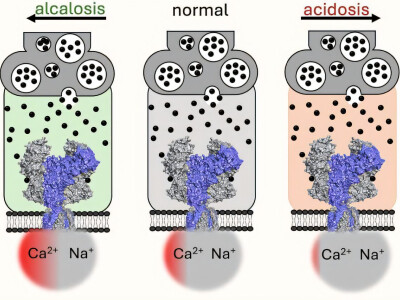
How the environment around synaptic receptors in the brain is constantly changing to reflect the continuous flux of information. Credit: Gabriela Popescu
New research from the University at Buffalo is challenging the longstanding assumption that the proportion of calcium in the current produced by NMDA receptors remain constant. Their study, which was recently published in the Proceedings of the National Academy of Sciences, has proven that assumption to be false.
"Our research reveals that small variations in the brain environment in which NMDA receptors operate can increase or decrease the amount of calcium in the currents fluxed by these receptors," said Gabriela K. Popescu, Ph.D., professor of biochemistry at UB. "This, in turn, could mean the difference between normal and impaired learning, memory and cognition, symptoms that accompany many neuropsychiatric conditions."
NDMA (N-methyl-D-aspartate) receptors have to key functions, transmitting information, which is determined by the amount of sodium flowing through the receptor, and the neuroplasticity relating to learning and neurodegeneration which is dependent on the amount of calcium flowing through the receptor.
"The textbooks tell us that the ratio of sodium to calcium in the currents generated by NMDA receptors is constant and therefore, if we measure how active the receptors are, we can infer how much calcium enters the cell," Popescu added. "Our new results show that we've been wrong in this assumption, and that the flow of sodium and calcium through NMDA receptors can vary independently of one another."
Knowing that the acidity of the external milieu can control the shape of the receptor, determining its activity level, the team looked toward the N-terminal domain or NTD as the source of ionic composition control.
"With this new insight we reasoned that, if acidosis controls calcium content through the NTD, other molecules that affect the NTD will also influence the calcium content," said Popescu. "And that turned out to be true, which means that the NTD is a lever that tunes the calcium content of the current."
"Excessive calcium currents through NMDA receptors cause neurodegeneration during intense or prolonged seizures, after a stroke or brain injury, and in several dementias, including Alzheimer's disease," Popescu concluded.
"So drugs that specifically reduce the calcium current but allow sodium-based transmission may be incredibly valuable. Our discovery pioneers a new way of thinking about what can be achieved with NMDA receptor-targeted drugs."