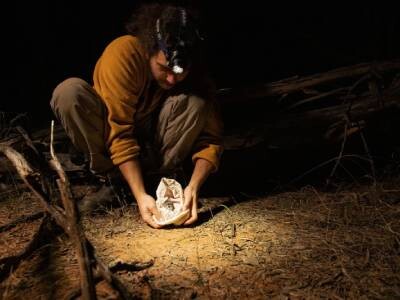
Lead JCU researcher Dr Sebastian Hoefer releasing a tagged mammal back into the wild. Credit: Lucca Amorim
James Cook University researchers have utilized AI to analyze more than 300,000 hours of mammal calls recorded throughout Australia, discovering a novel approach to mammal monitoring which could have far reaching impacts on conservation.
"Australia is the worst place for mammal extinctions in the world," said JCU Postdoctoral Research Fellow Dr. Sebastian Hoefer. "Many of our mammals are endemic, with highly restricted ranges and important ecological roles.
"Monitoring their populations is vital for effective conservation—yet traditional techniques are difficult to scale across large areas."
The work, published in a recent article in the journal Methods in Ecology and Evolution, was inspired by similar initiatives which yielded success in bird monitoring.
"AI processing of bird recordings has worked really well across entire ecoregions, so we wanted to see if the same technique could be applied to vocalizing mammals," he added.
The team fed the equivalent of 36 years of mammal recordings from across eastern Australia into the open source AI software called BirdNET.
"You can imagine it's a bit like ChatGPT," said Hoefer. "It's a machine learning recognizer that's been trained on birds, but we can tell it what we want to find.
"For example, we can input a single example call from a mammal—say, a male koala bellowing—and then instruct the system to locate all similar sounds across the recordings."
The team emphasize that the tool can help expand on our understanding of the presence and activity of patterns of mammals in the wild which could be a valuable resource for mammal management decisions.
"It was amazing to discover how effective using mammal calls can be to detect and monitor species over such large scales," concluded Dr. Hoefer. "This approach gives us new insights into where, when, and how species are active in the landscape. For example, deer have very specific vocalizing periods during the rutting season.
"By continuously recording throughout the year, we can identify these peak activity windows and plan targeted management or monitoring during those times."