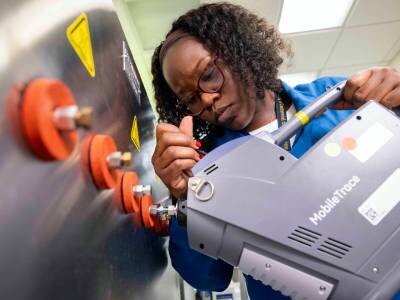
Ashley Fulton, Ph.D., U.S. Naval Research Laboratory research chemist, uses an ion mobility spectrometer to test a vapor generated from a trace explosive sensor testbed in Washington, D.C., Nov. 12, 2025. Fulton's research explores the development of non-contact fentanyl detection to increase the safety of first responders. Credit: U.S. Navy photo by Sarah Peterson
Researchers from the U.S. Naval Research Laboratory (NRL) working alongside Florida International University's (FIU) Global Forensic and Justice Center have developed a novel technique which can detect trace levels of fentanyl using handheld detection instruments.
Current field detection methods for fentanyl require bulk sampling or destructive preparation, increasing the risk for accidental exposure during field testing. With just 2 milligrams being potentially fatal if inhaled or absorbed through the skin, the non-contact detection approach developed could help keep first responders safer.
"Our sailors could come in contact with this substance, and it could possibly be used as a warfare agent. Having a detection method that's readily available is important for protection," said Ashley Fulton, Ph.D., chemistry researcher at NRL.
As opposed to traditional direct contact approaches which test for the presence of fentanyl, the tech developed by the NRL–FIU team instead targets N-phenylpropanamide (NPPA), a by-product molecule which fentanyl gives off as it breaks down.
Using a fine-tuned portable ion mobility spectrometer (IMS) paired with a novel silicon nanowire preconcentration array, the tech can detect NPPA at as little as 5 nanograms without being thrown off by various drug fillers.
"This work demonstrates a promising path toward rapid, non-contact detection of fentanyl that could help protect law enforcement officers, customs officials, and emergency responders," added Fulton. "Fentanyl is a highly potent drug that can cause overdose at very, very low concentrations. Law enforcement officers often feel high anxiety when they encounter unknown substances. This technology gives a preventative, presumptive identification so the proper care can be taken at the scene of a crime."
Field tests of the unit confirmed its ability to detect NPAA in both high-purity samples as well as complex street mixtures of the drug.
"The next step is demonstrating the full capability of the silicon nanowire system for trace detection," Fulton concluded. "Our goal is to have a prototype ready by the end of 2026."