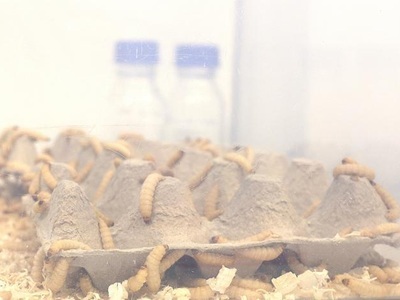
The larvae of the greater wax moth (Galleria mellonella) serve as an alternative infection model for investigating the pathogenicity of bacteria on a larger scale. Credit: HIOH/Madeleine Paditz
An interdisciplinary team at the Helmholtz Institute for One Health (Denmark) has demonstrated that the larva of the greater wax moth (Galleria mellonella) is a robust and ethically acceptable model for studying the human pathogenic bacterium Klebsiella pneumoniae on a larger scale.
Previously, studies to determine how virulent pathogens are in a living organism were conducted on mice or other mammalian models. But these studies are time- and resource-intensive and, for ethical reasons, not suitable for high-throughput testing.
Now, by testing 80 different strains of this K. pneumoniae, researchers demonstrated that, under standardized conditions, classic and particularly virulent variants can be clearly distinguished from one another in the wax moth larvae. The findings are published in The Lancet Microbe.
In the past, research using wax moth larvae was sometimes viewed critically because the study results were often difficult to compare due to a lack of standards. The Helmholtz research team therefore systematically reviewed and optimized the model in accordance with the ethical guidelines of the 3R principle (Replacement, Reduction, Refinement—replacing, reducing, and refining animal testing).
The decisive advantage of the model is its broad applicability. Before experiments on mammals are even considered, the model allows for broad screening of numerous bacterial variants or potential new active compounds in a living organism.
“The wax moth larva provides us with a biological system that we can use very effectively on a large scale,” said Elias Eger, corresponding author of the study and a researcher at Helmholtz. “While it is not a complete substitute for mammalian models, it works excellently as a tool for informed pre-selection. This means that only the most promising bacterial isolates need to be validated in more complex mammalian models afterward.”
The goal of the Helmholtz Institute for One Health is to decipher the spread and evolution of antibiotic-resistant pathogens at the interfaces between the environment, animals and humans. To analyze these dynamics on a large scale, researchers need practical and scalable in vivo models. The standardized Galleria model fills a critically important gap.
Data from Helmholtz Center for Infection Control